
Cybersecurity AI Automation 2026: 9 Essential Trends, Benefits, Risks & Complete Guide
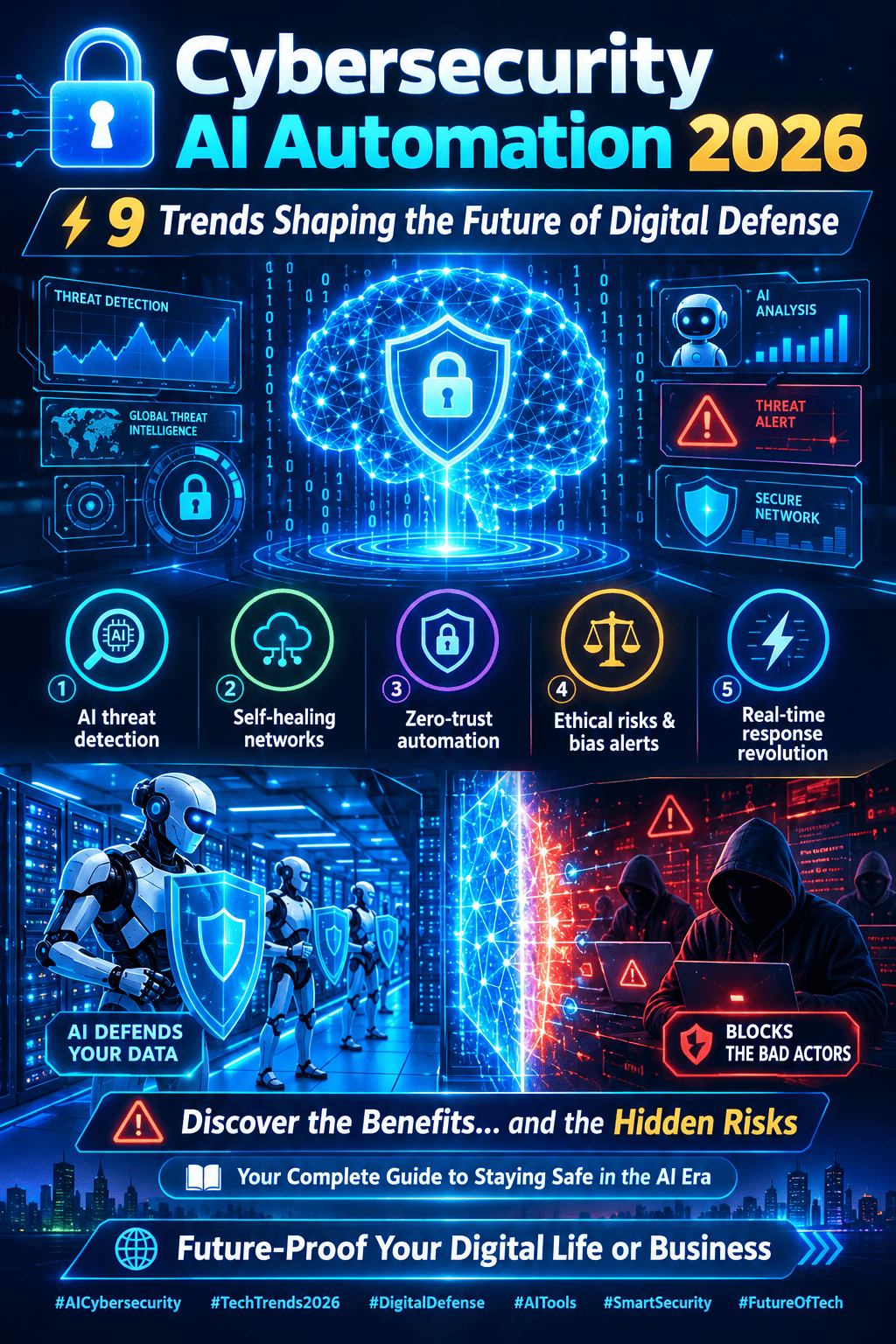
Cybersecurity is entering a new phase in which artificial intelligence, automation, cloud computing, security analytics, and autonomous software agents are increasingly working together. Organizations are no longer relying exclusively on manually reviewed alerts, traditional rules, or periodic security assessments. Instead, modern security operations are increasingly using AI to analyze enormous quantities of data, identify unusual behavior, prioritize threats, and support faster responses.
The growing importance of cybersecurity ai automation 2026 reflects this transformation. Artificial intelligence can help security teams process information at a scale that would be difficult to achieve manually. At the same time, attackers are also using AI to accelerate reconnaissance, social engineering, malware development, credential attacks, and other activities.
The World Economic Forum’s Global Cybersecurity Outlook 2026 describes AI as a major force reshaping cybersecurity. Its survey found that 94% of respondents viewed AI as the most significant driver of change in cybersecurity in 2026, while 87% identified AI-related vulnerabilities as the fastest-growing cyber risk during 2025.
This article explains what cybersecurity ai automation 2026 means, how it works, its major applications, benefits, risks, implementation strategies, and the trends organizations should understand.
Read More: How Does AI Automation Work in Customer Support? 9 Essential Steps, Benefits, Tools & Complete Guide
What Is Cybersecurity AI Automation 2026?
Cybersecurity ai automation 2026 refers to the use of artificial intelligence, machine learning, automation platforms, and increasingly AI agents to perform or support cybersecurity activities with limited manual intervention.
Traditional cybersecurity often depends on predefined rules. For example, a security system may generate an alert whenever an IP address produces an unusual number of login attempts. AI-based security systems can go further by examining patterns across users, devices, applications, locations, network traffic, and historical events.
Automation then turns analysis into action.
For example, an automated security workflow could:
- Detect suspicious login behavior.
- Analyze the user’s normal activity.
- Compare the event with known threat indicators.
- Assign a risk level.
- Investigate related events.
- Restrict a compromised account.
- Notify the security team.
- Create an incident record.
- Recommend or initiate remediation.
The goal is not necessarily to remove humans from cybersecurity. Instead, automation can reduce repetitive work and allow security professionals to concentrate on incidents requiring judgment, investigation, and strategic decisions.
Read More: Best GTM Digital Agents in AI Sales Automation: 9 Leading Tools and a Complete Guide
Why Is AI Automation Important in 2026?
The cybersecurity environment has become increasingly complex. Organizations operate across cloud platforms, remote endpoints, SaaS applications, APIs, mobile devices, data centers, and increasingly autonomous AI systems.
This creates enormous volumes of security data.
A security operations center may need to process authentication records, endpoint telemetry, network events, application logs, vulnerability information, threat intelligence, and cloud activity simultaneously. Human analysts cannot manually examine every event in real time.
This is where cybersecurity ai automation 2026 becomes particularly relevant.
The World Economic Forum reported that 77% of surveyed organizations had adopted AI for cybersecurity, with applications including phishing detection, intrusion and anomaly response, and user-behavior analytics. However, organizations also identified skills shortages, the need for human oversight, and uncertainty about risk as significant adoption challenges.
AI can help organizations manage this complexity by rapidly correlating information and identifying patterns that deserve attention.
Read More: What Is AI Automation Software? 9 Essential Facts, Benefits, Types & Applications
How Does Cybersecurity AI Automation Work?
A typical AI-powered security architecture combines several technologies.
1. Data Collection
The first stage involves collecting information from security and IT systems.
Common sources include:
- Firewalls
- Endpoint detection systems
- Identity platforms
- Cloud infrastructure
- Network devices
- Email systems
- Applications
- Authentication services
- Vulnerability scanners
- Security logs
- Threat-intelligence feeds
The broader the visibility, the more contextual information an AI system can potentially use.
2. Data Processing
Raw security information is often noisy and inconsistent. Automation platforms normalize and organize the data before analysis.
For example, several systems may report different events associated with the same user or device. Correlation allows these events to be considered together rather than treated as unrelated alerts.
3. AI Analysis
Machine-learning models and other AI techniques examine patterns in the collected information.
They can assist with:
- Anomaly detection
- User-behavior analysis
- Malware classification
- Phishing detection
- Risk scoring
- Threat correlation
- Incident summarization
- Vulnerability prioritization
Generative AI can also help analysts understand complex incidents by converting large quantities of technical information into concise explanations.
4. Automated Decision Support
After analyzing an event, the system can recommend an action.
For example, it may recommend isolating an endpoint, resetting credentials, blocking a suspicious domain, or investigating a particular process.
5. Automated Response
Depending on organizational policies and the level of authorization, automation can execute predefined actions.
High-risk actions may require human approval, while low-risk repetitive actions can sometimes be performed automatically.
6. Continuous Learning and Improvement
Modern security automation is not simply a one-time configuration. Organizations continuously update detection rules, models, threat intelligence, policies, and response procedures.
NIST has emphasized the importance of continuous monitoring for deployed AI systems because AI systems can behave differently across real-world environments and may face changing threats.
9 Major Applications of Cybersecurity AI Automation in 2026
1. Automated Threat Detection
One of the most important applications of cybersecurity ai automation 2026 is identifying suspicious activity.
AI can analyze large numbers of events and detect patterns associated with potential attacks.
For example, an unusual combination of geographic location, device behavior, login timing, and authentication activity may indicate account compromise even when no individual event appears highly suspicious.
This can help security teams discover threats earlier.
2. AI-Powered Phishing Detection
Phishing remains a major security concern because attackers continually change their messages and techniques.
AI can examine email content, sender behavior, URLs, attachments, communication patterns, and other signals to identify suspicious messages.
Generative AI also creates a defensive challenge because attackers can produce convincing messages more efficiently. Consequently, automated detection needs to evaluate behavior and context rather than relying only on obvious spelling mistakes or suspicious wording.
3. Automated Security Operations
Security operations centers generate enormous numbers of alerts.
Without effective prioritization, analysts can become overwhelmed by repetitive or low-value notifications.
AI automation can group related alerts, eliminate duplicates, summarize incidents, and identify relationships between seemingly separate events.
This can reduce unnecessary manual investigation.
4. Vulnerability Prioritization
Organizations can have thousands of known vulnerabilities across applications, operating systems, devices, and cloud environments.
Not every vulnerability represents the same practical risk.
AI can help prioritize vulnerabilities by considering factors such as:
- Asset importance
- Exposure
- Exploit availability
- Business impact
- Attack patterns
- Existing security controls
- Vulnerability severity
This helps security teams focus remediation resources where they may have the greatest security relevance.
5. Identity and Access Monitoring
Identity has become a critical security control as organizations adopt cloud services, remote work, APIs, and AI agents.
AI systems can identify unusual authentication behavior, privilege changes, impossible travel patterns, abnormal access times, and other indicators of compromised accounts.
The rise of autonomous agents adds another dimension. NIST has highlighted the importance of identification and authorization controls for AI agents because agents may access multiple datasets, tools, and applications.
6. Automated Incident Response
Incident response traditionally requires analysts to investigate alerts, identify affected systems, contain threats, and coordinate remediation.
Automation can accelerate parts of this process.
For example, a security workflow might automatically:
- Disable a compromised account.
- Quarantine an endpoint.
- Block a malicious domain.
- Collect forensic information.
- Open an incident ticket.
- Notify designated personnel.
Organizations should carefully define which actions can happen automatically and which require human authorization.
7. Security Copilots for Analysts
Generative AI can function as an assistant for security professionals.
A security analyst could ask an AI system to summarize an incident, explain a suspicious command, identify related alerts, or generate an investigation checklist.
This can reduce the time required to interpret technical information.
However, AI-generated recommendations should be validated, especially when they could result in disruptive security actions.
8. Threat Intelligence Analysis
Threat-intelligence teams process information from numerous sources.
AI can help organize and summarize this material, extract indicators, identify relationships, and connect emerging threat information with an organization’s existing environment.
This can transform large amounts of unstructured information into more usable intelligence.
9. AI Agent Security
One of the defining developments of cybersecurity ai automation 2026 is the emergence of agentic AI.
AI agents can perform multi-step tasks, interact with software tools, retrieve information, and make decisions within defined workflows.
This creates both defensive opportunities and new security risks.
NIST’s 2026 analysis of AI-agent security noted that agents introduce novel risks because model outputs are combined with software functionality. Fundamental cybersecurity practices remain relevant, but they need to be adapted for agent-based systems.
Read More: What Is AI Automation? A Complete Guide to How It Works, Benefits, Types, and Applications
Benefits of Cybersecurity AI Automation
Faster Detection
AI can process security data far more quickly than manual analysis.
Faster detection can shorten the time between an attack beginning and defenders recognizing suspicious activity.
Faster Response
Automation can execute predefined actions within seconds.
For some incidents, rapid containment can reduce potential damage.
Reduced Alert Fatigue
Security analysts may receive enormous numbers of alerts. AI can help prioritize events and combine related notifications.
This allows analysts to concentrate on incidents requiring deeper investigation.
Improved Scalability
A growing organization can generate increasingly large quantities of security telemetry.
Automation allows security processes to scale without requiring every additional event to be reviewed manually.
Better Security Context
AI can correlate information from multiple sources.
An isolated failed login might not be significant. A failed login followed by a privilege escalation and unusual data access may tell a very different story.
Support for Smaller Security Teams
Organizations with limited cybersecurity staff can use automation to handle repetitive activities and assist with analysis.
However, automation does not eliminate the need for qualified cybersecurity professionals.
Read More: Zapier Updates News: 5 Latest Features, Improvements, and What They Mean for Users
Risks and Challenges
Despite its advantages, cybersecurity ai automation 2026 introduces important risks.
AI Can Make Mistakes
AI systems can produce incorrect classifications, false positives, or false negatives.
An automated system that incorrectly identifies legitimate behavior as malicious could disrupt business operations.
Attackers Can Target AI Systems
Attackers may attempt prompt injection, data poisoning, model manipulation, or other techniques designed to influence AI behavior.
NIST research published in 2026 highlighted that fixed guardrails cannot be assumed to remain universally robust against adaptive adversarial prompts, reinforcing the importance of continuous security testing and monitoring.
Excessive Automation Can Increase Impact
Automation can make defensive systems faster, but an incorrectly configured automated response can also cause damage quickly.
For example, automatically disabling a critical service account during a false positive could interrupt essential operations.
Data Privacy
AI security systems may process sensitive information.
Organizations therefore need appropriate controls for data access, retention, privacy, encryption, and model usage.
Lack of Explainability
Security teams may need to understand why an AI system classified an event as dangerous.
If a system provides little usable explanation, analysts may have difficulty validating its recommendations.
AI Supply-Chain Risk
Organizations may rely on external models, APIs, datasets, plugins, agents, or software components.
Each additional dependency can introduce security and governance considerations.
Read More: What Are the Best AI Workflow Automation Tools? Top Solutions for Smarter Business Processes
AI Automation and the Changing Threat Landscape
The relationship between AI and cybersecurity is increasingly two-sided.
Defenders use AI to detect and respond to threats, while attackers use AI to increase the speed and scale of malicious activity.
Google Threat Intelligence reported in September 2026 that it had observed threat actors moving from basic AI prompting toward agentic workflows and AI-enabled automation. It described an incident in which attackers compromised a cloud resource and then used an agent-enabled workflow to plan, build, and execute a mass credential-harvesting campaign in less than six hours.
This development matters because cybersecurity has traditionally depended partly on the time required for attackers to conduct different stages of an operation.
AI can reduce that time.
Consequently, defenders increasingly need automated detection and response capabilities of their own.
Read More: 7 Essential and Effective Insights on How Google Determines Search Relevance
The Role of NIST in AI and Cybersecurity
NIST is developing guidance that addresses both sides of the relationship between AI and cybersecurity.
Its Cyber AI Profile organizes security considerations around three broad areas:
- Securing AI system components
- Conducting AI-enabled cyber defense
- Thwarting AI-enabled cyberattacks
The profile is designed to help organizations manage cybersecurity risks associated with AI while identifying opportunities to use AI for cybersecurity.
In August 2026, NIST also released an initial public draft of SP 1353, which explains practical ways AI can support analysis, planning, implementation, and monitoring of NIST Cybersecurity Framework 2.0 outcomes.
These developments demonstrate that AI security is increasingly being considered as part of broader cybersecurity risk management rather than as a completely separate technology issue.
Read More: What Is SEO Rank Tracking? A Complete Guide to Measuring Search Performance
How to Implement Cybersecurity AI Automation
Organizations should avoid introducing automation simply because AI is available.
A structured implementation process is more appropriate.
Step 1: Identify Security Objectives
Determine what the organization wants to improve.
Possible objectives include:
- Faster alert triage
- Better phishing detection
- Vulnerability prioritization
- Automated incident response
- Improved threat intelligence
- Reduced analyst workload
Step 2: Assess Existing Infrastructure
Review current security tools, data sources, processes, and integration capabilities.
Automation works best when relevant data is accessible and reliable.
Step 3: Start With Low-Risk Use Cases
Begin with activities such as alert summarization, log analysis, reporting, or investigation assistance.
Once confidence increases, organizations can consider more advanced automation.
Step 4: Establish Human Oversight
Define which actions require human approval.
A practical approach is to separate automated recommendations from automatically executed responses.
Step 5: Control AI Permissions
AI agents should receive only the access they require.
Least privilege, strong authentication, authorization controls, audit logging, and continuous monitoring are especially important for agentic systems.
Step 6: Test Before Deployment
Security teams should test AI systems against realistic scenarios, including malicious prompts, unexpected inputs, incorrect recommendations, and attempts to manipulate system behavior.
Step 7: Monitor Continuously
AI security cannot be treated as a “set and forget” technology.
Models, attackers, applications, infrastructure, and organizational risks change over time.
Continuous monitoring and periodic reassessment are therefore essential.
Read More: Do Google Reviews Help SEO? A Clear, Practical Guide to Rankings and Trust
Best Practices for Cybersecurity AI Automation 2026
A strong cybersecurity ai automation 2026 strategy should follow several principles.
Use AI to Augment People
AI should support skilled security professionals rather than automatically replacing human judgment.
Apply Least Privilege
AI systems and agents should have the minimum permissions required for their tasks.
Maintain Audit Trails
Organizations should record important AI decisions and automated actions so they can investigate what happened later.
Validate Critical Actions
High-impact actions should generally have additional safeguards.
Protect Training and Operational Data
Sensitive security information should be handled according to organizational security and privacy requirements.
Test Against Adversarial Behavior
Security testing should include attempts to manipulate AI systems, bypass safeguards, or influence automated workflows.
Keep Human Accountability
Organizations should clearly establish who is responsible for automated security decisions.
Future of Cybersecurity AI Automation
The future of cybersecurity ai automation 2026 is likely to involve increasingly integrated security platforms.
AI will not operate only as a separate chatbot or analytical tool. It will increasingly become part of security operations, identity management, cloud security, vulnerability management, endpoint protection, threat intelligence, and incident response.
Agentic systems may perform more complex sequences of tasks.
For example, an AI security agent could identify a suspicious identity, investigate associated activity, collect evidence, compare the activity with threat intelligence, prepare a risk assessment, and recommend containment.
However, greater autonomy also means greater responsibility.
The World Economic Forum has warned that AI agents can create new governance challenges involving credentials, permissions, prompt injection, accountability, and continuous verification.
Therefore, the future will not simply be about making security automation more autonomous. It will also be about making automated systems more controlled, observable, explainable, and accountable.
Read More: What Is Off-Page SEO? A Complete Guide to Building Authority and Trust
Cybersecurity AI Automation 2026 vs. Traditional Cybersecurity
Traditional cybersecurity and AI-enabled automation are not necessarily competing approaches.
Traditional controls remain fundamental.
Firewalls, encryption, secure authentication, access control, patch management, backups, endpoint protection, network segmentation, and security policies continue to provide essential protection.
AI can operate on top of these controls by improving analysis and automating selected workflows.
The most effective architecture is therefore likely to combine established cybersecurity principles with carefully governed AI capabilities.
In other words, cybersecurity ai automation 2026 should be viewed as an evolution of cybersecurity operations rather than a complete replacement for cybersecurity fundamentals.
Frequently Asked Questions (FAQ)
What is cybersecurity AI automation 2026?
Cybersecurity ai automation 2026 describes the use of AI, machine learning, automation platforms, and AI agents to detect threats, analyze security information, prioritize risks, and support or execute cybersecurity responses.
Why is AI important for cybersecurity in 2026?
AI can analyze large volumes of security information quickly and support activities such as threat detection, phishing analysis, incident triage, vulnerability prioritization, and automated response. At the same time, attackers are using AI to accelerate malicious operations.
Can AI completely replace cybersecurity professionals?
No. AI can automate repetitive tasks and support decision-making, but human expertise remains important for investigation, governance, risk assessment, architecture, incident management, and high-impact decisions.
What are the biggest risks of AI in cybersecurity?
Major risks include incorrect decisions, prompt injection, excessive permissions, data exposure, model manipulation, inadequate monitoring, and unsafe automated responses.
What are AI agents in cybersecurity?
AI agents are software systems capable of performing multi-step tasks with some degree of autonomy. In cybersecurity, they may investigate alerts, gather evidence, analyze threats, or execute approved response workflows.
Is automated incident response safe?
It can be useful when carefully designed, but organizations should establish clear authorization boundaries. Low-risk actions may be automated, while disruptive or high-impact actions may require human approval.
How does AI help security analysts?
AI can summarize incidents, correlate alerts, analyze logs, explain technical information, prioritize investigations, and generate recommendations. This can reduce repetitive work and allow analysts to focus on complex cases.
What is the role of NIST in AI cybersecurity?
NIST is developing guidance for securing AI systems and using AI for cybersecurity. Its Cyber AI Profile addresses securing AI components, AI-enabled cyber defense, and AI-enabled cyberattacks.
What is the most important principle for AI security?
A central principle is controlled automation. Organizations should combine AI capabilities with strong identity controls, least privilege, monitoring, testing, human oversight, and clear accountability.
Conclusion
Cybersecurity ai automation 2026 represents a significant development in the way organizations approach digital security. AI can process security information rapidly, identify patterns, prioritize alerts, support analysts, and automate selected defensive actions.
However, automation is not automatically secure simply because it uses advanced AI.
Organizations must also protect the AI systems themselves. This means managing permissions, securing data, testing models, monitoring behavior, maintaining audit trails, and establishing appropriate human oversight.
The cybersecurity environment of 2026 demonstrates why this balanced approach matters. AI is simultaneously becoming a defensive capability and an attack-enabling technology. Current research and industry observations show increasing movement toward AI-enabled and agentic cyber operations.
The organizations best positioned to benefit from cybersecurity ai automation 2026 will therefore be those that combine automation with established cybersecurity fundamentals, disciplined governance, continuous monitoring, and qualified human expertise.
AI can make cybersecurity faster and more scalable, but responsible implementation determines whether that speed becomes a security advantage or an additional source of risk.