
Best GTM Digital Agents in AI Sales Automation: 9 Leading Tools and a Complete Guide
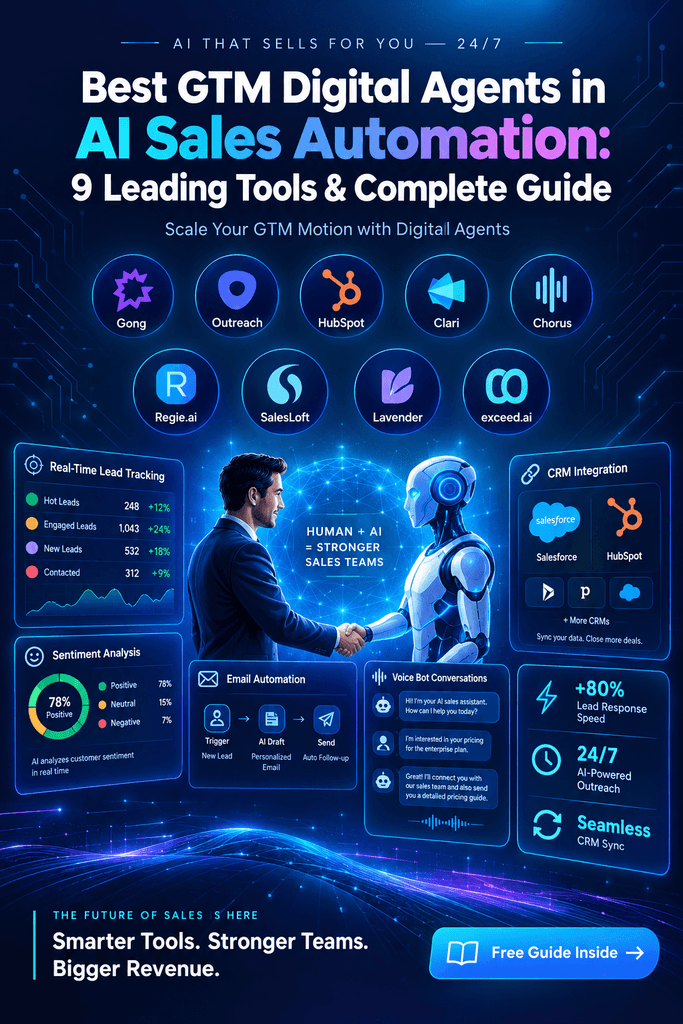
Go-to-market teams are rapidly changing how they find prospects, qualify leads, personalize outreach, and manage sales pipelines. Traditional sales development still depends heavily on repetitive activities such as prospect research, contact enrichment, email writing, follow-ups, lead scoring, and CRM updates. Modern AI agents can automate many of these activities while allowing sales professionals to concentrate on conversations, relationships, negotiation, and closing.
This shift has made ai sales automation one of the most important developments in modern B2B selling. Instead of using artificial intelligence only to generate an email or summarize a meeting, companies can now use AI agents to perform multi-step GTM workflows.
However, choosing a GTM digital agent is not simply about finding the tool with the most impressive demo. Different platforms specialize in different parts of the revenue process. Some operate as autonomous AI SDRs, while others focus on data enrichment, account research, inbound qualification, CRM workflows, or sales engagement.
As of September 2026, the market includes platforms such as 11x, Artisan, Clay, Regie.ai, Apollo, Qualified, Salesforce Agentforce, and other specialized systems. Independent comparisons also show that the category is increasingly divided into autonomous SDR platforms, data-and-orchestration systems, CRM-native agents, and inbound sales agents.
This guide explains what GTM digital agents do, how they support ai sales automation, which platforms are worth evaluating, and how businesses can choose a solution based on their specific sales process.
Read More:What Is AI Automation Software? 9 Essential Facts, Benefits, Types & Applications.
What Is AI Sales Automation?
Ai sales automation refers to the use of artificial intelligence, machine learning, automation workflows, and connected business systems to perform or assist with sales activities that traditionally require manual work.
Basic sales automation has existed for years. A conventional platform might automatically send an email after a prospect fills out a form or remind a salesperson to make a follow-up call.
AI-driven systems go further.
An AI sales agent can interpret information, research accounts, identify signals, generate personalized messaging, decide which action should happen next, classify responses, and sometimes execute those actions without requiring a salesperson to specify every individual step.
For example, a GTM workflow could begin when a target company receives new funding. An AI system could detect the event, identify relevant executives, research their responsibilities, determine whether the company fits the ideal customer profile, create personalized messaging, add qualified contacts to an outreach sequence, and notify a salesperson when a high-intent reply arrives.
That is substantially more sophisticated than simply scheduling an email.
Modern ai sales automation therefore combines automation with reasoning, context, data, and action.
How GTM Digital Agents Work
A GTM digital agent generally operates across several connected layers.
1. Data Collection
The system first gathers information about companies, people, industries, technologies, websites, job changes, funding events, hiring activity, and other business signals.
Data quality is critical because an intelligent workflow cannot compensate for consistently inaccurate input.
2. Account and Lead Research
AI agents can analyze websites, public information, CRM records, and other data sources to understand an account.
For example, the agent might determine whether a company:
- Fits a defined industry
- Has the appropriate employee count
- Uses a particular technology
- Recently raised funding
- Is hiring for relevant positions
- Has an identifiable business problem
- Matches an existing customer profile
Clay describes its Claygent agents as systems capable of researching and qualifying accounts, transforming business data, and supporting automated GTM workflows.
3. Personalization
Instead of creating the same message for every prospect, an AI agent can use account-specific information to produce customized messaging.
The quality of this personalization depends on the underlying research. Mentioning a prospect’s company name is not meaningful personalization if the rest of the message is generic.
4. Outreach
Some platforms can execute email, LinkedIn, calling, or other outbound activities. Others provide the intelligence and workflow layer while relying on separate engagement systems.
This distinction is important when evaluating ai sales automation platforms because two products may both describe themselves as AI sales agents while offering very different levels of autonomous execution.
5. Reply Classification
AI can categorize responses into groups such as interested, not interested, wrong person, objection, request for information, or unsubscribe.
This can help sales teams prioritize human attention.
6. CRM Updates
Agents can enrich records, update fields, create tasks, add contacts to sequences, and synchronize information with CRM systems.
The goal is to reduce administrative work while keeping the revenue team’s data current.
Read More: What Is AI Automation? A Complete Guide to How It Works, Benefits, Types, and Applications.
What Makes a Good GTM Digital Agent?
The strongest evaluation criteria are not necessarily the number of AI features advertised on a product page.
Businesses should examine several practical factors.
Data Quality
The agent needs reliable information about companies and people. Outdated job titles, incorrect contact details, or weak company data can undermine an otherwise sophisticated workflow.
Research Depth
An effective agent should be capable of more than basic firmographic enrichment. It should ideally interpret meaningful business signals and connect them to the sales strategy.
Personalization Quality
Generated messages should be relevant, accurate, and appropriate for the recipient.
Poor personalization can make automated outreach appear robotic rather than useful.
Workflow Control
Companies should be able to establish rules, approval requirements, qualification criteria, and safeguards.
Not every action should necessarily happen without human review.
CRM Integration
A GTM agent should work with the systems where customer information already lives.
Deliverability
For outbound campaigns, deliverability is fundamental. Large volumes of automated messages are not useful if they damage sender reputation or consistently reach spam folders.
Reporting
Teams need to know what the system actually accomplished.
Useful measurements include qualified conversations, positive replies, meetings, opportunities, conversion rates, and revenue-related outcomes.
Read More: Zapier Updates News: 5 Latest Features, Improvements, and What They Mean for Users.
9 Leading GTM Digital Agents to Consider in 2026
There is no universal winner because these platforms solve different problems. The following tools represent important categories within the current GTM agent market.
1. 11x Alice
11x’s Alice is positioned as an autonomous AI SDR designed to manage outbound activities. Its official product information describes capabilities including market tracking, account research, identifying buying signals, engaging decision-makers, CRM synchronization, and automated outbound workflows.
Alice is particularly relevant to organizations looking for a more autonomous form of ai sales automation.
Its workflow can involve identifying prospects, researching accounts, creating engagement strategies, and continuing interactions based on responses and signals.
Key capabilities
- Market and account research
- Lead identification
- Buying-signal monitoring
- Account-based engagement
- CRM synchronization
- Personalized outreach
- Automated lead activation
One important consideration is that autonomous systems still require appropriate targeting, messaging guidelines, data quality, and human oversight.
For companies with large addressable markets and repetitive outbound motions, 11x is one of the platforms worth evaluating.
2. Artisan Ava
Artisan positions Ava as an AI BDR capable of handling significant portions of outbound prospecting and engagement.
Industry comparisons place Artisan among the major autonomous AI SDR platforms in 2026.
The appeal of an all-in-one platform is straightforward: instead of assembling separate prospect databases, research tools, messaging systems, and engagement workflows, businesses can attempt to manage more of the process in one environment.
Key capabilities
- Prospect discovery
- Automated research
- Personalized outreach
- Campaign management
- Follow-up automation
- Sales development workflows
Artisan can be particularly relevant to teams that want a relatively packaged approach to ai sales automation rather than building many separate workflows.
The key evaluation question should be whether its bundled data and execution capabilities match the company’s target market.
3. Clay
Clay occupies a somewhat different position.
Rather than functioning solely as an autonomous AI SDR, Clay has developed into a broader GTM infrastructure and orchestration platform. Its documentation describes access to data providers, AI agents, enrichment, lead scoring, personalization, CRM updates, and automated workflows.
Claygent is particularly useful for research and data transformation.
In 2026, Clay introduced Claygent Builder, allowing users to build, test, and deploy GTM agents using natural-language instructions.
Clay also reports that its AI agents can conduct web research and transform first-party and third-party data into usable fields for GTM workflows.
Key capabilities
- Account research
- Lead enrichment
- AI-powered qualification
- Intent-signal analysis
- Personalization
- Workflow orchestration
- CRM data operations
- Custom GTM agents
Clay is especially relevant for companies that want flexible ai sales automation rather than a single fixed sales agent.
Its flexibility can also introduce complexity. Teams need to design and maintain their workflows carefully.
4. Regie.ai
Regie.ai has developed a strong position around AI-powered sales engagement and prospecting.
Rather than focusing exclusively on replacing SDR activity, Regie.ai has historically emphasized combining AI with human sales teams and sales engagement workflows.
This makes it useful for organizations that want to introduce ai sales automation while maintaining significant human involvement.
Key capabilities
- AI-assisted prospecting
- Sales engagement
- Content generation
- Automated sequences
- Personalization
- AI sales agents
- Human-AI collaboration
One advantage of this approach is that sales representatives can remain involved in decisions that require judgment.
This can be valuable for companies selling complex products where the quality of the conversation matters more than simply increasing outbound volume.
5. Apollo
Apollo has increasingly positioned itself as an agentic, end-to-end GTM platform.
In October 2025, Apollo announced an agentic GTM platform intended to connect prospecting, outbound, inbound, deal execution, and data enrichment. In March 2026, it announced its AI Assistant for executing GTM workflows through natural-language instructions.
Apollo’s current platform also emphasizes prospecting, outreach, dialing, integrations, and connected GTM workflows.
Key capabilities
- Prospect discovery
- Contact and company data
- Outreach
- Calling
- AI-assisted workflows
- CRM and GTM integrations
- Deal-related assistance
- Data enrichment
Apollo can therefore be attractive to companies that want data, prospecting, engagement, and AI capabilities within a connected environment.
Its 2026 documentation also describes the ability to use Apollo through external AI tools while retaining Apollo as the system of record.
6. Qualified Piper
Qualified is particularly relevant to inbound GTM.
Its AI agent, Piper, is designed around website-based sales engagement, helping businesses interact with website visitors and move qualified prospects toward sales conversations.
This represents an important category of ai sales automation: not every sales agent needs to perform cold outbound.
For companies with substantial website traffic, inbound qualification can be one of the highest-value areas for automation.
Typical use cases
- Website visitor engagement
- Lead qualification
- Conversational marketing
- Meeting scheduling
- Routing prospects
- Identifying high-intent visitors
The primary question for buyers is whether the business generates enough qualified inbound traffic for an autonomous conversational agent to create meaningful value.
7. Salesforce Agentforce
Salesforce approaches AI sales automation from a CRM-native perspective.
Instead of operating primarily as an external AI SDR, Agentforce can operate within a broader customer relationship management environment.
This approach can be valuable for organizations that already use Salesforce extensively and want AI functionality connected directly to their customer records, workflows, and sales processes.
Potential use cases
- Lead qualification
- CRM assistance
- Sales research
- Follow-up support
- Customer information retrieval
- Workflow execution
- Sales task automation
The major advantage of a CRM-native architecture is context.
An agent that can access appropriate customer information, opportunity records, previous interactions, and business processes may be able to make more context-aware decisions than an isolated automation tool.
8. AiSDR
AiSDR is another platform frequently included in 2026 AI SDR comparisons.
Independent comparisons describe it as a meeting-focused AI SDR platform designed to automate prospect research, outreach, and follow-up.
Its positioning can appeal to smaller organizations that want a more straightforward path into AI-assisted outbound.
Potential strengths
- Automated prospecting
- Research
- Email outreach
- Follow-ups
- Reply handling
- Meeting generation
The most important question is whether the system’s targeting and messaging quality are appropriate for the company’s specific market.
A smaller company should not assume that a lower-cost automated system automatically produces better economics. The cost of poor targeting, irrelevant outreach, and damaged sender reputation can exceed software costs.
9. Overloop and Signal-Based GTM Agents
Signal-based GTM platforms represent another growing category.
Instead of sending messages simply because a prospect exists in a database, these systems attempt to trigger sales activity based on events such as job changes, website activity, company changes, or other buying signals.
A recent 2026 comparison identifies platforms and agents including Overloop, Claygent, Common Room RoomieAI, UserGems Gem-E, Demandbase Agentbase, Unify Agents, RegieGO, 11x Alice, and 6sense RevvyAI as examples of different signal-driven GTM approaches.
This model can make ai sales automation more contextual.
Instead of asking, “Who can we email?”, the workflow asks, “Which qualified prospect has just demonstrated a reason to start a conversation?”
Read More: What Are the Best AI Workflow Automation Tools? Top Solutions for Smarter Business Processes.
AI Sales Automation vs. Traditional Sales Automation
Traditional automation generally follows predetermined rules.
For example:
If a lead fills out a form, send an email.
If the lead opens the email, wait two days.
If the lead clicks a link, create a task.
This approach is predictable and useful.
AI automation introduces interpretation.
The system can potentially examine a company’s website, understand its industry, analyze an executive’s role, compare the account with an ideal customer profile, and determine which message might be appropriate.
Therefore, ai sales automation can handle more ambiguous tasks than conventional rule-based automation.
However, greater flexibility also creates greater risk.
A rule-based system usually does exactly what it was programmed to do.
An AI agent may make an incorrect interpretation.
That is why governance remains essential.
Read More: 7 Essential and Effective Insights on How Google Determines Search Relevance.
Benefits of AI Sales Automation
Higher Operational Efficiency
Sales teams can spend less time performing repetitive research and administrative work.
Faster Lead Response
AI systems can process inbound signals and initiate appropriate workflows rapidly.
Greater Personalization
Agents can incorporate account-level information into outreach.
Better Scalability
A team can potentially research and process far more accounts than it could manually.
Reduced Administrative Burden
CRM updates, data enrichment, classification, and task creation can be automated.
Continuous Monitoring
Agents can monitor relevant signals rather than waiting for a salesperson to manually discover them.
Consistent Processes
Well-designed automation can apply qualification criteria and messaging rules consistently.
These benefits explain why ai sales automation is becoming part of the operating model for many modern revenue organizations.
Apollo’s August 2026 survey, for example, reported that 97% of respondents were using AI and that 58% reported measurable benefits within 60 days, while only 6% believed AI would ultimately replace members of their sales or marketing teams.
That finding supports a broader shift toward AI augmentation rather than simply treating AI as a substitute for human salespeople.
Read More: What Is SEO Rank Tracking? A Complete Guide to Measuring Search Performance.
Limitations of AI Sales Agents
Despite rapid progress, GTM agents are not perfect.
Inaccurate Research
An agent can misunderstand information or rely on outdated data.
Generic Messaging
AI-generated content can become repetitive when workflows are poorly configured.
Hallucinations
A system may generate a statement that is not supported by the available evidence.
Deliverability Problems
Automated outbound campaigns can damage sender reputation when poorly configured.
Weak Qualification
An AI agent may interpret a prospect’s intent incorrectly.
Integration Complexity
Connecting CRM, data providers, calendars, email systems, and other platforms can require substantial configuration.
Human Oversight Requirements
High-value conversations still frequently require human judgment.
For these reasons, successful ai sales automation should be treated as an operational system rather than a magic button.
Read More: Do Google Reviews Help SEO? A Clear, Practical Guide to Rankings and Trust.
How to Choose the Right GTM Digital Agent
The first step is to define the sales problem.
Do not begin by asking which AI agent is the most advanced.
Begin by asking what work needs to be automated.
Step 1: Define Your ICP
Identify the industries, company sizes, geographic markets, job roles, technologies, and business characteristics that define an ideal customer.
Step 2: Map the Existing Sales Process
Document how leads currently move from identification to qualification, outreach, meeting, opportunity, and close.
Step 3: Identify Repetitive Work
Look for activities that consume significant employee time without requiring sophisticated human judgment.
Step 4: Determine the Required Level of Autonomy
Decide whether the AI should:
- Recommend actions
- Draft actions
- Execute actions after approval
- Execute actions independently
Step 5: Evaluate Data Sources
Determine where the agent gets company and contact information.
Step 6: Test Real Prospects
Never evaluate only with a polished vendor demo.
Give the system real examples from your target market and examine the results.
Step 7: Measure Business Outcomes
Track metrics such as:
- Positive reply rate
- Qualified meeting rate
- Show rate
- Opportunity creation
- Pipeline contribution
- Conversion rate
- Cost per qualified opportunity
- Sales-cycle impact
This approach makes ai sales automation measurable rather than purely experimental.
Read More: What Is Off-Page SEO? A Complete Guide to Building Authority and Trust.
Which Agent Fits Which Sales Motion?
Different sales organizations have different needs.
For Autonomous Outbound
Platforms such as 11x and Artisan are relevant to companies looking for autonomous AI SDR capabilities.
For Flexible GTM Engineering
Clay is particularly relevant when the team wants to construct custom research, enrichment, scoring, and workflow systems.
For AI-Assisted Sales Engagement
Regie.ai is worth evaluating when human sellers remain central to the process.
For a Connected GTM Platform
Apollo is relevant to teams seeking a broader environment covering prospecting, engagement, data, and agentic workflows.
For Inbound Sales
Qualified’s approach is relevant when website visitors represent a major source of potential opportunities.
For CRM-Native Automation
Salesforce Agentforce may make sense for organizations that want AI deeply integrated into their Salesforce environment.
The appropriate choice depends on the workflow rather than on a generic “best AI agent” label.
Read More: What Is Local SEO? A Complete Guide to Boosting Your Local Visibility.
How to Implement AI Sales Automation Successfully
Buying the software is only the beginning.
A successful implementation requires a structured process.
Start With One Workflow
Do not automate the entire sales organization on day one.
Choose one repetitive process, such as inbound lead qualification or account research.
Establish Guardrails
Specify what the AI can and cannot do.
For example, require human approval before sending messages to strategic accounts.
Create Messaging Standards
Define your brand voice, prohibited claims, approved terminology, customer examples, and compliance requirements.
Use High-Quality Data
AI output is strongly influenced by the quality of its inputs.
Maintain Human Oversight
Sales representatives should be able to review important interactions and intervene when necessary.
Monitor Results
Review performance continuously.
A workflow that performs well during its first month may need adjustment as markets, messaging, and buyer behavior change.
Read More: How SEO Marketing Works – A Clear Guide to Traffic, Rankings, and Conversions.
The Future of AI Sales Automation
The next stage of ai sales automation is likely to involve interconnected agents rather than isolated AI tools.
One agent may research an account.
Another may evaluate buying signals.
Another may prepare personalized messaging.
A CRM agent may update the opportunity.
A sales assistant may prepare the representative for the meeting.
This creates an agentic GTM architecture in which specialized systems cooperate across the revenue process.
Clay’s recent product development illustrates this broader direction. Its 2026 platform increasingly emphasizes reusable agents, workflow orchestration, external data, account research, and integrations with AI tools.
Apollo is pursuing a similar direction by connecting AI assistance with prospecting, outreach, data, inbound workflows, and deal execution.
The important change is that AI is moving from being a writing assistant toward becoming an execution layer.
Frequently Asked Questions (FAQ)
What is an AI sales agent?
An AI sales agent is software that uses artificial intelligence to perform or assist with sales activities such as prospect research, lead qualification, outreach, follow-up, and meeting scheduling.
Is AI sales automation the same as an AI SDR?
Not exactly. An AI SDR is usually focused on sales-development activities, especially prospecting and outbound engagement. Ai sales automation is a broader concept that can include CRM automation, inbound qualification, research, lead scoring, sales engagement, and other GTM workflows.
Which GTM agent is best for prospect research?
Clay is particularly focused on flexible AI-powered research and GTM data workflows. Its Claygent agents can research accounts and transform information into fields that can be used in downstream workflows.
Can AI agents replace sales representatives?
AI agents can automate many repetitive sales-development activities, but current evidence does not support treating them as universal replacements for sales teams. Apollo’s 2026 survey found that only 6% of surveyed sales and marketing leaders believed AI would ultimately replace team members, while many respondents emphasized productivity and augmentation.
Is AI sales automation suitable for small businesses?
Yes, particularly when a small business has repetitive lead-generation or qualification processes. However, the system should be chosen according to sales volume, budget, data requirements, and the amount of human oversight available.
Does AI sales automation work for B2B companies?
B2B companies are a major use case because their sales processes often involve account research, qualification, outbound prospecting, CRM management, and multistep follow-up.
What is the biggest risk of AI sales agents?
One of the biggest risks is allowing an automated system to act on inaccurate data or produce inappropriate messaging at scale. Strong data validation, approval rules, monitoring, and deliverability controls can reduce this risk.
Should companies automate outbound sales completely?
Complete automation is not necessarily appropriate for every business. High-value accounts, complex products, regulated industries, and relationship-driven sales processes may require more human involvement.
Conclusion
The market for GTM digital agents has developed rapidly, and the meaning of ai sales automation has expanded far beyond automated email sequences.
Modern systems can research accounts, identify prospects, interpret signals, personalize messaging, execute outreach, qualify responses, update CRM records, and support sales representatives throughout the customer journey.
Platforms such as 11x, Artisan, Clay, Regie.ai, Apollo, Qualified, Salesforce Agentforce, and AiSDR represent different approaches to this evolving market. Some emphasize autonomous outbound sales, while others focus on data, orchestration, inbound conversion, CRM intelligence, or human-AI collaboration.
The right solution depends on the company’s GTM motion, data quality, sales cycle, customer profile, technical environment, and desired level of autonomy.
For that reason, businesses should evaluate agents by the specific work they can reliably perform rather than by marketing claims alone.
The most effective implementation of ai sales automation is likely to be one that combines machine speed and scale with human judgment. AI can handle repetitive research, classification, enrichment, and workflow execution, while sales professionals continue to manage strategic relationships, nuanced conversations, negotiation, and complex decisions.
As GTM platforms become increasingly agentic, the central question will no longer be whether AI can participate in sales. It will be how intelligently businesses design the collaboration between AI agents, data, automation, and human sellers.