
AI Automation Platform: 9 Essential Benefits, Features, Types & Applications
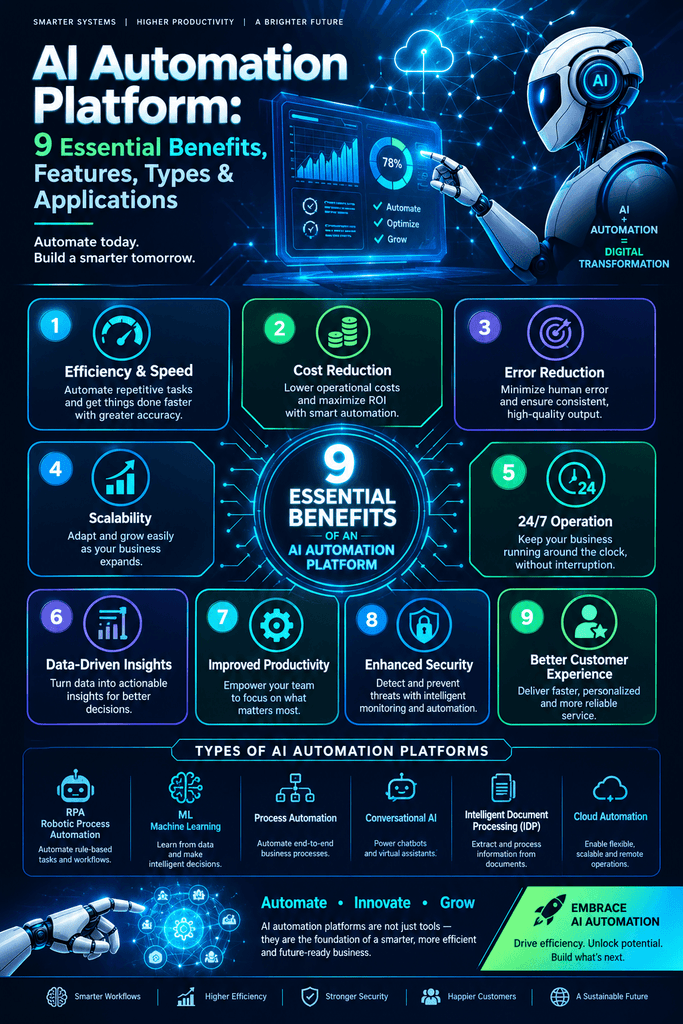
Artificial intelligence has changed the way businesses approach repetitive work, data processing, customer service, marketing, sales, and decision-making. Instead of depending entirely on manual processes, organizations can now use intelligent software to understand information, make predictions, generate content, communicate with customers, and complete routine tasks automatically.
An ai automation platform brings many of these capabilities together in one environment. It can connect artificial intelligence models with business applications, databases, workflows, communication tools, and other digital systems. This allows organizations to create automated processes that can respond to information and perform actions with limited human intervention.
AI automation is becoming increasingly important because businesses need to operate faster while controlling costs and maintaining consistent quality. However, automation is not simply about replacing manual tasks. Modern systems can also help employees make better decisions, identify important information, personalize customer experiences, and focus on work that requires creativity and human judgment.
This article explains what an ai automation platform is, how it works, its major features, different types, benefits, applications, limitations, implementation strategies, and future potential.
What Is an AI Automation Platform?
An ai automation platform is a software environment that combines artificial intelligence with workflow automation. It allows users to design processes in which AI systems analyze information, generate outputs, make decisions, or trigger actions automatically.
Traditional automation generally follows predefined instructions. For example, a system might send an email whenever a customer completes a registration form. AI-powered automation can go further by interpreting the customer’s message, identifying its intent, determining an appropriate response, and then performing the required action.
In simple terms, the technology connects three important elements:
- Artificial intelligence: Understands, analyzes, predicts, or generates information.
- Automation: Performs tasks according to predefined or intelligent workflows.
- Integration: Connects different software systems so that information can move between them.
For example, a business could create a workflow in which a new customer inquiry is received, analyzed by an AI model, categorized according to its subject, entered into a customer relationship management system, and assigned to the appropriate employee.
The exact capabilities vary between platforms. Some focus on no-code automation, while others provide advanced development tools, AI agents, application programming interfaces, data processing, and enterprise workflow management.
Read More: AI Automation News: 11 Major Trends, Breakthroughs & Business Impacts in 2026
How Does an AI Automation Platform Work?
An ai automation platform generally operates through a workflow consisting of triggers, data processing, AI analysis, decisions, and actions.
1. Trigger
Every automated workflow normally begins with a trigger. A trigger is an event that tells the system that a process should start.
Examples include:
- Receiving an email
- Submitting an online form
- Creating a new customer record
- Uploading a document
- Completing a purchase
- Receiving a support request
- Updating a database
- Reaching a scheduled time
The trigger provides the starting point for the automation.
2. Data Collection
After the workflow starts, the system collects relevant information. Data may come from websites, applications, databases, documents, emails, customer records, or other connected services.
The quality of the collected information is important because AI systems depend heavily on the data provided to them.
3. AI Processing
The artificial intelligence component analyzes the information. Depending on the workflow, it may classify text, summarize documents, extract information, recognize patterns, generate content, answer questions, or make predictions.
For instance, an AI system could examine hundreds of customer messages and determine whether each message relates to billing, technical support, sales, or another category.
4. Decision or Routing
The workflow then determines what should happen next. A simple automation may use predefined rules, while a more sophisticated system can use AI-generated classifications or recommendations.
A high-priority customer complaint, for example, could automatically be routed to a senior support employee.
5. Automated Action
The final stage involves taking action. The system might send an email, update a CRM record, create a task, generate a report, notify an employee, update a database, or initiate another workflow.
This combination of intelligence and automation makes modern systems considerably more flexible than traditional rule-based automation.
Read More: AI Automation in Healthcare: 9 Essential Benefits, Applications, Challenges & Future Trends
Key Features of an AI Automation Platform
A modern ai automation platform can contain numerous capabilities. The exact feature set depends on the provider and intended use.
AI Model Integration
One of the most important features is the ability to connect AI models to workflows. Platforms may support large language models, machine-learning systems, speech recognition, computer vision, or specialized AI services.
This allows organizations to use AI without building every model from scratch.
Workflow Builder
A visual workflow builder allows users to design automated processes. Many platforms use drag-and-drop interfaces so that users can connect triggers, conditions, AI actions, and applications without extensive programming.
Advanced platforms may also allow developers to write custom code when more flexibility is required.
No-Code and Low-Code Development
No-code and low-code capabilities make automation accessible to nontechnical employees. Marketing teams, sales professionals, operations managers, and support departments can create workflows without becoming software engineers.
Low-code tools still provide programming options for organizations that need greater customization.
Application Integrations
Businesses rarely use a single software application. They may use CRM systems, accounting software, email platforms, project management applications, databases, communication tools, and analytics systems.
An effective automation environment connects these services so that information can move between them automatically.
AI Agents
Some advanced systems support AI agents capable of completing multi-step tasks. Instead of performing one isolated AI action, an agent can interpret a goal, determine the necessary steps, use available tools, and complete a workflow.
Human supervision can still be included for sensitive or important decisions.
Data Processing
Automation frequently requires information from structured and unstructured sources. Platforms may provide tools for processing spreadsheets, documents, emails, databases, and other data.
AI can then extract useful information and transform it into a format that another system can understand.
Monitoring and Analytics
Organizations need to know whether automated workflows are working correctly. Monitoring features can provide information about successful executions, errors, processing times, and other performance indicators.
Analytics can help organizations identify bottlenecks and improve workflows over time.
Security and Access Control
Business automation often involves sensitive information. Therefore, authentication, authorization, encryption, access controls, audit logs, and data-management policies can be important features.
Enterprise users may also require role-based permissions so that employees can access only the workflows and information relevant to their responsibilities.
Read More: AI Automation Solutions: 9 Essential Benefits, Types, Tools & Implementation Guide
Types of AI Automation Platforms
Not every organization requires the same type of automation system. Several categories have emerged to serve different needs.
No-Code AI Automation Platforms
No-code systems are designed for users with limited technical knowledge. They generally provide visual workflow builders and preconfigured integrations.
They are useful for small businesses and departments that want to automate routine processes quickly.
Low-Code AI Automation Platforms
Low-code platforms provide visual tools while allowing developers to add custom code. They provide a balance between simplicity and flexibility.
These systems are particularly useful when standard integrations are not enough to meet business requirements.
Enterprise AI Automation Platforms
Enterprise systems are designed for large organizations with complex security, governance, integration, and scalability requirements.
They may provide centralized administration, advanced monitoring, extensive API access, compliance controls, and sophisticated workflow management.
AI Agent Platforms
AI agent platforms focus on autonomous or semi-autonomous systems that can perform multiple tasks. They can be used for research, customer service, data analysis, software development, sales assistance, and other workflows.
Because agents can make decisions dynamically, organizations should establish appropriate controls and human-review mechanisms.
Industry-Specific Platforms
Some automation solutions are designed for specific industries. Healthcare, finance, manufacturing, retail, education, logistics, and legal organizations can have specialized requirements.
Industry-focused systems may include specialized workflows, terminology, integrations, and compliance features.
Read More: Cybersecurity AI Automation 2026: 9 Essential Trends, Benefits, Risks & Complete Guide
Benefits of an AI Automation Platform
An ai automation platform can provide significant advantages when implemented correctly.
1. Increased Productivity
Automation reduces the amount of time employees spend performing repetitive tasks. Instead of copying information between applications or responding manually to routine requests, employees can concentrate on more valuable activities.
For example, an automated system can collect customer information, update multiple records, and notify the appropriate employee without requiring someone to perform each step manually.
2. Faster Business Processes
Manual processes can create delays. A request may remain in an inbox until an employee has time to review it.
Automated workflows can respond almost immediately. This can improve customer service and reduce internal processing times.
3. Lower Operational Costs
Automation can reduce the amount of repetitive manual work required to operate a business. The financial benefit depends on the process, implementation cost, scale, and complexity.
The goal should not simply be to eliminate employees. Instead, organizations can use automation to increase the amount of productive work employees can accomplish.
4. Improved Accuracy
Manual data entry can lead to mistakes. Automated workflows can consistently perform repetitive actions according to defined instructions.
AI can also extract information from documents and classify large volumes of data, although AI-generated results still require appropriate validation.
5. Better Customer Experiences
Customers increasingly expect fast and personalized service. Automated systems can analyze customer requests, provide immediate assistance, recommend relevant information, and route complicated cases to human specialists.
This creates a combination of automation and human support rather than forcing customers to interact exclusively with machines.
6. Scalability
A workflow that processes 50 requests per day may become difficult to manage manually when demand rises to 5,000 requests.
Automation can help organizations handle larger workloads without increasing manual effort at the same rate.
7. Better Decision Support
AI can process large quantities of information much faster than humans. It can identify patterns, summarize reports, detect anomalies, and provide recommendations.
However, important decisions should remain subject to human review when errors could cause significant consequences.
8. Consistent Processes
Automated workflows can standardize how tasks are completed. This is especially valuable when several employees or departments need to follow the same process.
Consistency can improve quality control and make business operations easier to monitor.
9. More Efficient Use of Employees
The greatest value may come from allowing employees to spend less time on repetitive work.
Employees can instead focus on strategy, creativity, communication, relationship building, problem-solving, and other activities where human judgment provides significant value.
Read More: How Does AI Automation Work in Customer Support? 9 Essential Steps, Benefits, Tools & Complete Guide
Applications of AI Automation
The potential applications of an ai automation platform extend across almost every business function.
Marketing Automation
Marketing teams can automate content workflows, audience segmentation, campaign analysis, lead qualification, email personalization, and reporting.
AI can analyze customer behavior and help marketers understand which messages or campaigns are most relevant to different audiences.
Sales Automation
Sales teams can use AI automation to identify leads, summarize customer conversations, update CRM records, prepare follow-up messages, and prioritize opportunities.
For example, after a sales call, AI could summarize the conversation and automatically add important information to the appropriate customer record.
Customer Support
Customer support is one of the most common areas for intelligent automation.
A system can classify incoming requests, search a knowledge base, provide answers to common questions, and escalate complex cases to human agents.
This allows support teams to handle higher volumes while preserving human involvement for difficult situations.
Finance and Accounting
Automation can assist with invoice processing, expense categorization, financial document extraction, payment reminders, and reporting.
AI can extract relevant information from invoices and transfer it into accounting systems, reducing repetitive data entry.
Financial decisions and compliance-sensitive activities, however, require appropriate controls and professional oversight.
Human Resources
HR departments can automate employee onboarding, document collection, interview scheduling, frequently asked questions, and internal communications.
AI can also help organize resumes and summarize candidate information, although recruitment systems should be designed carefully to reduce unfair or discriminatory outcomes.
Healthcare
Healthcare organizations can use intelligent automation for administrative workflows, appointment management, document processing, patient communication, and information organization.
Because healthcare data is sensitive, organizations must pay particular attention to privacy, security, regulatory requirements, and human oversight.
E-Commerce
Online retailers can automate product categorization, customer support, order notifications, personalized recommendations, inventory alerts, and marketing activities.
AI can also analyze customer behavior and identify purchasing patterns.
Education
Educational organizations can use automation for administrative tasks, student communication, scheduling, content organization, and learning support.
Teachers and educational institutions should maintain human oversight, particularly when automated systems influence assessment or student outcomes.
IT Operations
IT teams can use automation to monitor systems, classify incidents, generate summaries, create tickets, and perform routine maintenance tasks.
AI can help identify unusual patterns and support technicians when troubleshooting technical problems.
Read More: Best GTM Digital Agents in AI Sales Automation: 9 Leading Tools and a Complete Guide
AI Automation Platform vs Traditional Automation
Traditional automation generally follows explicit rules.
For example:
If a customer submits a form → send an email → create a CRM record.
An AI-powered workflow can interpret information before deciding what to do.
For example:
Customer submits a message → AI identifies intent → evaluates urgency → selects workflow → updates CRM → generates response → alerts employee if necessary.
The key difference is that AI can work with less structured information.
Traditional automation is highly predictable when rules are clear. AI automation is more flexible but can introduce uncertainty because AI models can occasionally produce incorrect or unexpected results.
Therefore, the two approaches are not competitors in every situation. Many of the best workflows combine traditional rules with AI capabilities.
Read More: What Is AI Automation Software? 9 Essential Facts, Benefits, Types & Applications
How to Choose an AI Automation Platform
Selecting an ai automation platform requires more than comparing feature lists.
Define the Business Problem
Start by identifying the process that needs improvement. Avoid automating a poorly designed process simply because automation is available.
Ask:
- What task consumes the most employee time?
- Where do errors occur?
- Which processes cause delays?
- What information must move between applications?
- What outcome should automation produce?
Evaluate Integrations
Check whether the platform supports the applications your organization already uses.
An excellent AI model is not enough if it cannot connect effectively with your CRM, database, communication tools, or other critical systems.
Consider Ease of Use
A technically powerful platform may still fail if employees cannot use it effectively.
Consider whether business users can create and modify workflows without excessive technical assistance.
Examine Security
Security should be a major consideration when automation involves customer, financial, employee, or confidential business information.
Review authentication, authorization, encryption, data retention, audit logging, and administrative controls.
Check Scalability
A workflow should continue performing effectively as the organization grows.
Consider the number of users, workflow executions, data volume, AI requests, integrations, and future expansion requirements.
Review Pricing
Pricing structures can vary significantly. Some platforms charge based on users, workflow executions, AI usage, features, data volume, or subscription levels.
Organizations should estimate total operating costs rather than focusing only on the initial subscription price.
How to Implement AI Automation Successfully
Successful implementation requires careful planning.
Step 1: Identify Repetitive Processes
Create a list of repetitive activities across the organization. Prioritize tasks that consume substantial time but do not require complex human judgment.
Step 2: Map the Existing Workflow
Document every stage of the process.
Identify:
- Inputs
- Decisions
- Applications
- Human approvals
- Outputs
- Exceptions
- Common errors
This makes it easier to determine which steps should be automated.
Step 3: Start With a Small Pilot
Do not immediately automate the entire organization.
Choose one well-defined process and test it. A small pilot allows the team to discover problems before expanding the system.
Step 4: Establish Human Oversight
Not every AI decision should happen automatically.
Create approval steps for high-risk activities. Employees should be able to review, correct, reject, or override automated results where appropriate.
Step 5: Measure Performance
Establish measurable objectives before implementation.
Useful metrics may include:
- Processing time
- Error rate
- Cost per transaction
- Employee hours saved
- Customer response time
- Conversion rate
- Workflow failure rate
Step 6: Improve Continuously
Automation should not be treated as a one-time project. Analyze workflow performance regularly and update processes as business requirements change.
Challenges and Limitations
Despite its advantages, an ai automation platform is not a solution to every business problem.
AI Errors
AI systems can produce inaccurate information. These errors may occur because of ambiguous inputs, incomplete data, model limitations, or inappropriate instructions.
Critical workflows therefore require validation and human review.
Data Quality Problems
Poor-quality data can produce poor results. Duplicate records, missing information, inconsistent formats, and outdated databases can reduce automation effectiveness.
Organizations should improve their data foundations before automating important processes.
Integration Complexity
Connecting several applications can become technically complicated. Differences in APIs, data structures, authentication systems, and permissions can create challenges.
Security Risks
More integrations can create additional security considerations. Organizations must carefully manage credentials, permissions, access levels, and sensitive data.
Employee Resistance
Employees may worry that automation will eliminate their jobs or make their roles less important.
Clear communication and training can help employees understand that automation can also remove repetitive tasks and allow them to focus on higher-value responsibilities.
Cost of Implementation
Although automation can reduce long-term costs, implementation may require investment in software, development, training, integration, security, and maintenance.
A realistic return-on-investment analysis is therefore essential.
Best Practices for AI Automation
Organizations can improve their results by following several principles.
Keep Humans in the Loop
Human oversight is especially important for decisions involving significant financial, legal, medical, employment, or customer consequences.
Use AI Where It Adds Value
Do not use AI simply because it is available. If a straightforward rule can solve a problem reliably, traditional automation may be preferable.
Protect Sensitive Information
Use appropriate access controls and data-management policies. Only provide AI systems with the information necessary for the task.
Build Exception Handling
Every workflow should consider what happens when something goes wrong.
For example, if an AI system cannot confidently classify a customer request, the workflow should send the case to a human rather than making an uncertain decision automatically.
Document Workflows
Maintain documentation explaining what each automation does, which systems it accesses, who owns it, and what happens when errors occur.
Monitor Results
Regular monitoring can identify workflow failures, unexpected AI outputs, increasing costs, and other issues before they become major problems.
The Future of AI Automation
The future of automation is likely to involve increasingly capable AI agents, multimodal systems, intelligent decision support, and deeper integration between software applications.
An ai automation platform may increasingly function as an operational layer connecting employees, AI models, business applications, and digital information.
Instead of creating individual automations for isolated tasks, businesses may build intelligent systems capable of coordinating multiple processes.
For example, a future workflow could receive a customer request, understand the customer’s history, analyze relevant documents, determine the appropriate response, update several systems, prepare a personalized message, and request human approval when necessary.
AI agents may also become more capable of working across multiple applications. Rather than simply generating text, they can potentially interact with software tools and complete sequences of actions.
However, greater autonomy will make governance even more important. Organizations will need clear policies covering security, accountability, transparency, data privacy, human oversight, and acceptable AI behavior.
AI Automation and the Human Workforce
One of the most important questions surrounding intelligent automation is its effect on employment.
Automation can eliminate some repetitive activities, but jobs usually consist of many different tasks. A system may automate certain tasks within a role without completely replacing the person performing that role.
Employees may increasingly work alongside AI systems. They can provide judgment, creativity, empathy, strategic thinking, relationship management, and oversight while automated systems handle repetitive information-processing tasks.
This means organizations should focus not only on automation but also on employee training.
Workers who understand how to use AI effectively can become more productive and valuable within modern digital organizations.
Is an AI Automation Platform Worth It?
Whether an ai automation platform is worthwhile depends on the organization’s goals, processes, data, technical environment, and budget.
It can be particularly valuable when a business has:
- Large volumes of repetitive tasks
- Multiple disconnected applications
- High customer-service workloads
- Significant amounts of unstructured data
- Frequent manual data entry
- Slow approval processes
- A need to scale operations
- Employees spending substantial time on routine activities
However, automation should not be introduced simply because it is technologically impressive.
The strongest projects begin with a measurable business problem and then determine whether AI and automation can provide a better solution.
Conclusion
An ai automation platform combines artificial intelligence, workflow automation, and software integration to create intelligent digital processes. It can help organizations analyze information, automate repetitive activities, connect applications, improve productivity, and deliver faster customer experiences.
Its value extends across marketing, sales, customer support, finance, healthcare, education, human resources, e-commerce, and IT operations. Modern platforms can range from simple no-code workflow tools to sophisticated enterprise environments supporting AI agents and complex business processes.
However, successful automation requires more than selecting software. Organizations need high-quality data, clear workflows, appropriate integrations, strong security, employee training, monitoring, and human oversight.
The most effective approach is usually gradual. Businesses should identify a valuable repetitive process, test automation on a small scale, measure the results, improve the workflow, and then expand it to other areas.
As artificial intelligence becomes more capable, intelligent automation is likely to become an increasingly important part of digital business operations. Organizations that combine automation with responsible governance and human expertise can use these technologies not merely to reduce repetitive work, but to create faster, more flexible, and more productive ways of working.
Frequently Asked Questions (FAQ)
What is an AI automation platform?
An ai automation platform is software that combines artificial intelligence with automated workflows. It can analyze information, make classifications or recommendations, and trigger actions across connected applications.
What can an AI automation platform automate?
It can automate activities such as data entry, customer support, email processing, lead qualification, document processing, reporting, notifications, CRM updates, and many other repetitive workflows.
Do AI automation platforms require coding?
Not always. Many platforms provide no-code or low-code visual workflow builders. Advanced projects may still require programming for custom integrations or specialized functionality.
What is the difference between AI and automation?
Automation follows instructions to perform tasks automatically, while AI can interpret information, identify patterns, generate content, and make predictions. Combining the two allows workflows to respond more intelligently to changing inputs.
Can small businesses use AI automation?
Yes. Small businesses can use automation for customer communication, marketing, sales, scheduling, data management, invoicing, and administrative processes. Cloud-based tools can make sophisticated capabilities accessible without building an AI system from scratch.
Is AI automation safe?
It can be safe when implemented with appropriate security, access controls, monitoring, data protection, and human oversight. High-risk workflows should not depend entirely on unverified AI decisions.
How should a business start with AI automation?
The best starting point is usually a repetitive, measurable process with a clear business objective. The organization can test a small workflow, measure its performance, resolve problems, and expand automation gradually.
Will AI automation replace employees?
AI automation is more likely to change many tasks and job responsibilities than eliminate every role. Employees can increasingly use AI to handle repetitive work while focusing on creativity, judgment, communication, strategy, and other higher-value activities.
What is the biggest benefit of AI automation?
The biggest benefit is the ability to combine automated execution with intelligent information processing. This can help organizations complete repetitive work faster while allowing employees to focus on tasks that require human expertise.
What should businesses consider before choosing a platform?
Businesses should evaluate integrations, security, scalability, usability, AI capabilities, pricing, data handling, monitoring, support, and the complexity of their workflows before selecting a solution.