
AI Automation in Healthcare: 9 Essential Benefits, Applications, Challenges & Future Trends
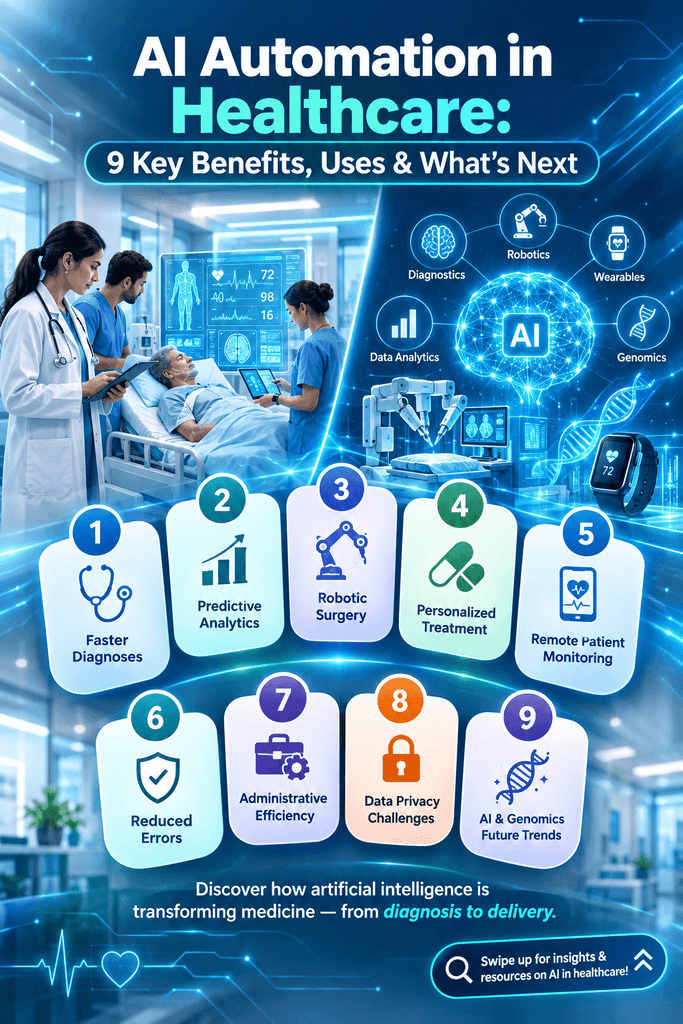
Healthcare is becoming increasingly dependent on digital technologies to improve patient care, reduce administrative workloads, manage medical information, and support better clinical decisions. Among the technologies transforming the sector, artificial intelligence (AI) and automation are particularly significant. Together, they can help healthcare organizations process large volumes of information, streamline repetitive tasks, identify patterns, and deliver services more efficiently.
ai automation in healthcare refers to the use of artificial intelligence technologies combined with automated workflows to perform or support healthcare-related tasks that traditionally require substantial human effort. These systems can assist with administrative operations, patient communication, medical documentation, clinical decision support, scheduling, billing, monitoring, and other processes.
The objective is not simply to replace human workers. Instead, effective automation can allow doctors, nurses, technicians, administrators, and other healthcare professionals to spend more time on activities that require professional judgment, empathy, communication, and direct patient interaction.
As healthcare organizations generate enormous quantities of medical and operational data, intelligent automation is becoming increasingly valuable. However, successful implementation requires careful attention to privacy, security, accuracy, regulation, ethics, and human oversight.
Read More: AI Automation Solutions: 9 Essential Benefits, Types, Tools & Implementation Guide
What Is AI Automation in Healthcare?
ai automation in healthcare combines artificial intelligence, machine learning, natural language processing, computer vision, predictive analytics, and workflow automation to complete tasks with limited manual intervention.
Traditional automation generally follows predefined rules. For example, a scheduling system may automatically send an appointment reminder at a specified time. AI-powered automation can go further by analyzing information, recognizing patterns, interpreting language, and adapting its response according to the available data.
For example, an intelligent healthcare system could analyze a patient’s appointment history, identify missed appointments, send personalized reminders, and notify staff when additional follow-up may be necessary.
The technology can operate across different areas of a healthcare organization, including hospitals, clinics, laboratories, pharmacies, insurance operations, telemedicine services, and public health programs.
A typical automated healthcare workflow may involve the following stages:
- Data collection: Information is gathered from electronic health records, forms, medical devices, messages, or other sources.
- Data processing: AI systems organize and interpret the available information.
- Analysis: Algorithms identify patterns, classifications, risks, or relevant information.
- Decision support: The system produces recommendations, alerts, summaries, or predictions.
- Workflow execution: Automation triggers an appropriate action.
- Human review: Healthcare professionals evaluate important outputs when human judgment is required.
This combination of intelligence and automation makes modern healthcare workflows faster and potentially more consistent.
Read More: Cybersecurity AI Automation 2026: 9 Essential Trends, Benefits, Risks & Complete Guide
Why Is AI Automation in Healthcare Important?
Healthcare professionals face enormous workloads. Doctors and nurses must care for patients while also dealing with documentation, scheduling, communication, reporting, billing, and information management.
ai automation in healthcare can reduce some of these repetitive responsibilities. By automating suitable processes, healthcare organizations can improve operational efficiency without removing the human element from patient care.
Another major advantage is the ability to process large amounts of information quickly. A healthcare organization may generate thousands of records, laboratory results, images, messages, and administrative documents every day. AI-based systems can help organize and analyze this information far more rapidly than manual processes.
Automation can also improve consistency. Human employees can become tired or overwhelmed, particularly when handling repetitive tasks. Properly designed automated workflows can perform standardized operations consistently while leaving complex decisions to qualified professionals.
Read More: How Does AI Automation Work in Customer Support? 9 Essential Steps, Benefits, Tools & Complete Guide
9 Essential Applications of AI Automation in Healthcare
1. Automated Patient Scheduling
Scheduling is one of the most common administrative challenges in healthcare. Patients may need appointments with different specialists, while staff must coordinate availability, cancellations, rescheduling, and reminders.
ai automation in healthcare can make scheduling more efficient by analyzing appointment availability and matching patients with appropriate time slots.
Automated systems can also send reminders through email, text messages, applications, or other communication channels. If a patient cancels an appointment, an intelligent system may identify another suitable patient and help fill the available slot.
This can reduce administrative work and potentially decrease the number of missed appointments.
2. Medical Documentation and Transcription
Documentation takes a significant amount of time for many healthcare professionals. Clinicians may need to record patient histories, examination findings, treatment plans, and follow-up information.
AI-powered speech recognition and natural language processing can convert spoken conversations into structured text. Advanced systems can identify important information from clinical conversations and organize it into appropriate sections.
ai automation in healthcare can therefore support medical documentation by reducing manual typing and helping clinicians prepare records more efficiently.
However, automated documentation should not be treated as automatically accurate. Medical professionals must review generated records because errors in names, medications, measurements, diagnoses, or clinical details can have serious consequences.
3. Clinical Decision Support
Clinical decision support is another important application. AI systems can analyze medical information and provide clinicians with relevant insights.
For example, an algorithm may identify patterns in laboratory results, medical histories, imaging information, or vital signs that deserve further attention.
ai automation in healthcare can support clinicians by bringing relevant information together and highlighting potential risks. This can be particularly useful when healthcare professionals must review large quantities of information quickly.
Importantly, AI-generated recommendations should generally function as decision-support tools rather than unquestionable medical authorities. Qualified professionals remain responsible for interpreting the information within the appropriate clinical context.
4. Medical Imaging Analysis
Medical imaging produces enormous amounts of visual information. Radiology, pathology, dermatology, ophthalmology, and other specialties can benefit from computer vision technologies.
AI systems can be trained to recognize specific patterns in medical images. Depending on the application, they may help identify abnormalities or prioritize images that require closer review.
The role of ai automation in healthcare in medical imaging is particularly valuable because automated systems can process images rapidly and consistently.
Nevertheless, medical imaging AI requires rigorous validation. Image quality, patient characteristics, equipment differences, and variations between healthcare environments can affect performance. Human specialists should therefore remain involved in appropriate diagnostic workflows.
5. Patient Communication and Virtual Assistants
Patients frequently ask healthcare organizations questions about appointments, services, preparation instructions, medications, operating hours, and follow-up procedures.
AI-powered virtual assistants can answer many routine questions automatically. They can also direct patients toward appropriate services or escalate more complicated requests to human staff.
ai automation in healthcare can make patient communication available beyond traditional office hours. This may improve accessibility and reduce pressure on call centers.
However, automated communication must clearly distinguish between general information and medical advice. Systems should have safeguards for urgent or potentially dangerous situations and direct patients to qualified healthcare professionals or emergency services when appropriate.
6. Billing and Revenue Cycle Management
Healthcare billing involves many repetitive processes, including claim preparation, coding support, eligibility verification, payment tracking, and identifying missing information.
AI and automation can analyze billing information and identify inconsistencies or incomplete records.
ai automation in healthcare can help organizations streamline revenue cycle operations by reducing repetitive data entry and improving workflow coordination.
Automated systems may also identify unusual billing patterns or claims that require additional review. Human specialists can then investigate exceptions rather than manually examining every transaction.
7. Medication Management
Medication management requires accuracy because incorrect medication information can create significant risks.
AI systems can support medication-related workflows by checking information, identifying potential inconsistencies, generating reminders, and helping healthcare professionals review relevant records.
In suitable environments, ai automation in healthcare may assist with medication adherence programs by reminding patients about scheduled doses or appointments.
Automation can also support pharmacies and healthcare organizations with inventory management, prescription processing, and operational coordination.
Because medication decisions can have serious consequences, automated systems must be carefully validated and used within appropriate professional and regulatory frameworks.
8. Remote Patient Monitoring
Wearable devices and connected medical technologies can continuously collect information such as heart rate, blood oxygen levels, activity, glucose measurements, or other health indicators, depending on the device.
AI systems can analyze these streams of information and identify patterns that may require attention.
ai automation in healthcare can support remote monitoring by helping healthcare teams prioritize alerts instead of manually reviewing every data point.
For example, an automated system could identify a significant change in a patient’s measurements and notify the appropriate healthcare professional.
This approach may be particularly useful for chronic disease management and post-treatment monitoring. However, automated alerts must be carefully designed because excessive false alarms can overwhelm healthcare workers and reduce the effectiveness of monitoring systems.
9. Predictive Analytics and Preventive Care
Healthcare organizations increasingly use predictive analytics to identify potential risks before they become serious problems.
AI models can analyze historical and real-time data to estimate the likelihood of particular outcomes. Depending on the application, these systems may help identify patients who could benefit from additional monitoring or preventive intervention.
ai automation in healthcare can connect predictive insights with workflows. Instead of simply generating a risk score, an automated system could trigger an appropriate review, reminder, or follow-up process.
Predictive tools should be evaluated carefully because predictions are probabilistic rather than certain. A risk estimate should support professional judgment rather than determine patient care automatically.
Read More: What Is AI Automation Software? 9 Essential Facts, Benefits, Types & Applications
Benefits of AI Automation in Healthcare
Improved Efficiency
One of the clearest benefits is improved operational efficiency. Automated systems can perform repetitive tasks quickly, allowing healthcare professionals to focus on higher-value responsibilities.
Reduced Administrative Burden
Healthcare workers often spend considerable time on paperwork and administrative activities. ai automation in healthcare can reduce manual effort in areas such as scheduling, documentation, communication, and data processing.
Faster Information Processing
AI can analyze large quantities of structured and unstructured information rapidly. This can help organizations identify relevant information without requiring staff to manually review every record.
Improved Patient Experience
Patients generally value convenient communication, shorter administrative processes, and timely access to information. Automated reminders, virtual assistants, and streamlined scheduling can improve the overall patient experience.
Better Resource Allocation
Automation can help healthcare organizations understand demand, prioritize workloads, and allocate resources more effectively.
For example, intelligent systems can help identify appointment patterns or operational bottlenecks, allowing administrators to make better-informed decisions.
Continuous Availability
Unlike traditional office-based workflows, automated digital systems can operate continuously. This can support patient communication and monitoring outside normal working hours.
Potential Cost Savings
Reducing repetitive manual work may lower certain operational costs. However, organizations must consider implementation, integration, maintenance, training, security, and compliance expenses before assuming that automation will automatically reduce costs.
Challenges of AI Automation in Healthcare
Despite its potential, ai automation in healthcare introduces significant challenges.
Data Privacy
Healthcare information is highly sensitive. AI systems may process medical histories, diagnoses, laboratory results, images, medications, and other personal information.
Organizations must establish strong privacy controls and comply with applicable healthcare and data-protection regulations.
Cybersecurity
Healthcare systems are attractive targets for cybercriminals because they contain valuable personal and medical information.
Automated systems can increase the number of digital connections and therefore require strong security measures. Encryption, access controls, authentication, monitoring, vulnerability management, and incident-response procedures are essential.
Algorithmic Bias
AI models can produce biased results when training data is incomplete, unrepresentative, or affected by historical inequalities.
ai automation in healthcare should therefore be developed and evaluated using diverse and appropriate datasets.
Organizations should monitor model performance across relevant patient populations rather than assuming that a model performs equally well for everyone.
Accuracy and Reliability
AI systems can make mistakes. A model may produce an incorrect classification, overlook an important detail, or generate an inappropriate recommendation.
For healthcare applications, even a small error rate can have serious consequences. Validation, monitoring, testing, and human oversight are therefore critical.
Integration With Existing Systems
Healthcare organizations often use multiple software systems. Integrating new AI technologies with electronic health records, laboratory systems, imaging platforms, billing software, and other infrastructure can be complicated.
Poor integration can create additional work instead of reducing it.
Staff Training
Healthcare professionals need appropriate training to use AI systems effectively.
Training should cover not only technical operation but also the limitations of AI, interpretation of outputs, privacy requirements, escalation procedures, and appropriate human oversight.
Regulatory and Ethical Issues
Healthcare AI raises important ethical questions concerning accountability, transparency, informed consent, privacy, fairness, and professional responsibility.
Organizations must determine who is responsible when an automated recommendation is incorrect and establish clear governance policies before deploying high-impact systems.
Read More: What Is AI Automation? A Complete Guide to How It Works, Benefits, Types, and Applications
How Does AI Automation in Healthcare Work?
A typical AI automation workflow begins with data collection. Information may come from electronic health records, medical devices, laboratory systems, patient questionnaires, imaging equipment, or communication platforms.
The system then processes the data. Depending on the application, machine learning, natural language processing, computer vision, or other AI techniques may be used.
Next, the system generates an output. This could be a classification, prediction, summary, recommendation, alert, or extracted piece of information.
The automation layer then determines what should happen next.
For example:
Patient data → AI analysis → Risk identification → Automated alert → Human review → Appropriate action
This workflow demonstrates an important principle: the most valuable systems do not necessarily eliminate people from the process. Instead, they connect AI capabilities with human expertise.
Read More: Best GTM Digital Agents in AI Sales Automation: 9 Leading Tools and a Complete Guide
AI Automation vs. Traditional Healthcare Automation
Traditional automation typically follows predetermined rules.
For example:
If appointment is tomorrow → send reminder.
AI-based automation can process more complex information.
For example:
Analyze patient communication and appointment history → identify potential follow-up needs → recommend an appropriate workflow.
This distinction does not mean that AI should replace conventional automation. In many healthcare environments, the most effective approach combines both.
Simple and predictable tasks can be handled by rule-based automation, while AI can be applied where pattern recognition, language understanding, or prediction provides additional value.
Read More: What Are the Best AI Workflow Automation Tools? Top Solutions for Smarter Business Processes
Key Technologies Behind AI Automation in Healthcare
Several technologies contribute to modern healthcare automation.
Machine Learning
Machine learning allows systems to identify patterns in data and generate predictions or classifications.
Natural Language Processing
Natural language processing enables computers to process human language. It can support documentation, information extraction, chatbots, and communication workflows.
Computer Vision
Computer vision enables machines to interpret visual information. It is particularly relevant to medical imaging and image-based analysis.
Generative AI
Generative AI can produce text, summaries, explanations, and other content. In healthcare, it may support documentation, patient communication, research, and administrative workflows when used with appropriate safeguards.
Robotic Process Automation
Robotic process automation can perform repetitive digital tasks according to predefined workflows. Combining RPA with AI can create more flexible automated systems.
Internet of Medical Things
Connected medical devices can collect and transmit health information. AI can analyze this information and generate relevant insights or alerts.
Read More: How Can an AI Search Monitoring Platform Improve SEO Strategy?
Steps to Implement AI Automation in Healthcare
Healthcare organizations should approach implementation systematically.
Step 1: Identify the Right Problem
Organizations should begin with a clearly defined problem rather than adopting AI simply because it is technologically attractive.
Step 2: Evaluate the Data
The organization should determine whether the necessary data is available, accurate, representative, secure, and legally usable.
Step 3: Select an Appropriate Technology
Different problems require different technologies. A chatbot, predictive model, computer vision system, and workflow automation platform serve different purposes.
Step 4: Establish Governance
Clear policies should define access, accountability, security, validation, human oversight, and escalation procedures.
Step 5: Conduct Testing
Systems should be tested before widespread deployment. Testing should examine accuracy, reliability, security, usability, bias, and performance across relevant scenarios.
Step 6: Start With a Controlled Deployment
A pilot program can help organizations identify unexpected problems before expanding the system.
Step 7: Train Healthcare Staff
Employees should understand how the system works, what its limitations are, and when human intervention is necessary.
Step 8: Monitor Performance
AI systems should not be treated as permanently finished products. Performance can change as data, workflows, patient populations, and operating environments change.
Step 9: Continuously Improve
Feedback from healthcare professionals and patients can help organizations improve automated workflows over time.
Read More: Zapier Updates News: 5 Latest Features, Improvements, and What They Mean for Users
The Future of AI Automation in Healthcare
The future of ai automation in healthcare is likely to involve increasingly connected systems rather than isolated AI tools.
Healthcare organizations may use AI to connect patient communication, documentation, scheduling, monitoring, analytics, and administrative workflows into coordinated digital ecosystems.
Generative AI may become increasingly useful for summarizing complex information and supporting documentation. Multimodal AI may combine text, images, audio, and numerical data to provide broader context.
AI agents could also perform multi-step administrative workflows. Instead of simply answering a question, an agent might retrieve relevant information, complete a routine administrative process, communicate with a patient, and escalate exceptions to a human employee.
However, greater automation will increase the importance of governance. As systems become more capable, organizations will need stronger controls over data access, accountability, security, validation, and human oversight.
The long-term goal should not be maximum automation. It should be appropriate automation—using technology where it improves safety, efficiency, accessibility, and patient outcomes while preserving human responsibility where it matters most.
Best Practices for Safe AI Automation in Healthcare
Healthcare organizations should follow several principles when implementing AI-powered automation:
- Protect patient information with strong security controls.
- Use high-quality and representative data.
- Validate systems before deployment.
- Maintain meaningful human oversight.
- Clearly define responsibility and accountability.
- Monitor models after implementation.
- Regularly evaluate accuracy and bias.
- Train staff appropriately.
- Establish clear escalation procedures.
- Communicate transparently with patients when appropriate.
- Use automation for suitable tasks rather than forcing every process into an AI workflow.
These principles can help organizations gain the advantages of automation without overlooking its risks.
Conclusion
ai automation in healthcare is transforming how healthcare organizations manage information, communicate with patients, support clinicians, and perform administrative operations. From scheduling and documentation to medical imaging, remote monitoring, billing, and predictive analytics, intelligent automation can reduce repetitive workloads and help healthcare professionals work more efficiently.
At the same time, healthcare is a high-stakes environment where errors can have serious consequences. Privacy, cybersecurity, bias, accuracy, regulation, integration, and human oversight must therefore remain central to every implementation strategy.
The most effective approach is not to replace healthcare professionals with machines. Instead, AI should be used to augment human expertise and automate appropriate repetitive processes. When technology handles routine work, professionals can devote more attention to clinical reasoning, communication, empathy, and patient-centered care.
As AI technologies continue to advance, ai automation in healthcare will likely become an increasingly important component of modern healthcare infrastructure. Organizations that combine intelligent technology with responsible governance, high-quality data, strong security, and human oversight will be better positioned to use automation safely and effectively.
Frequently Asked Questions (FAQ)
What is ai automation in healthcare?
ai automation in healthcare is the use of artificial intelligence technologies and automated workflows to perform or support healthcare-related tasks. Applications include scheduling, documentation, patient communication, medical image analysis, monitoring, billing, and decision support.
What are the main benefits of AI automation in healthcare?
Major benefits include reduced administrative workload, faster information processing, improved workflow efficiency, better resource allocation, continuous digital support, and potentially improved patient experiences.
Can AI replace doctors and nurses?
AI is generally better viewed as a support technology rather than a complete replacement for healthcare professionals. Doctors, nurses, and other specialists provide clinical judgment, empathy, contextual understanding, and accountability that automated systems cannot fully reproduce.
Is AI automation safe for patients?
Safety depends on how the technology is designed, validated, implemented, and monitored. High-quality data, rigorous testing, cybersecurity, privacy protection, and human oversight are essential for safe healthcare AI applications.
How is AI used in medical diagnosis?
AI can analyze medical images, laboratory information, patient histories, and other data to identify patterns that may assist healthcare professionals. These systems should be appropriately validated and should not automatically replace professional clinical judgment.
What is the biggest challenge of AI automation in healthcare?
One of the biggest challenges is balancing technological efficiency with patient safety, privacy, accuracy, accountability, and human oversight. Healthcare organizations must ensure that automation improves workflows without introducing unacceptable risks.
How can hospitals begin using AI automation?
Hospitals can begin by identifying a specific, repetitive, measurable problem, evaluating the available data, selecting an appropriate technology, conducting a controlled pilot, training staff, establishing governance procedures, and continuously monitoring performance.
What is the future of healthcare automation?
The future is likely to include more intelligent workflows, AI agents, multimodal systems, predictive analytics, connected medical devices, automated documentation, and personalized digital services. Human oversight and responsible governance will remain essential as these technologies become more capable.