
Gridone AI Automation: A Complete Guide to Features, Benefits, Use Cases, and Future Potential
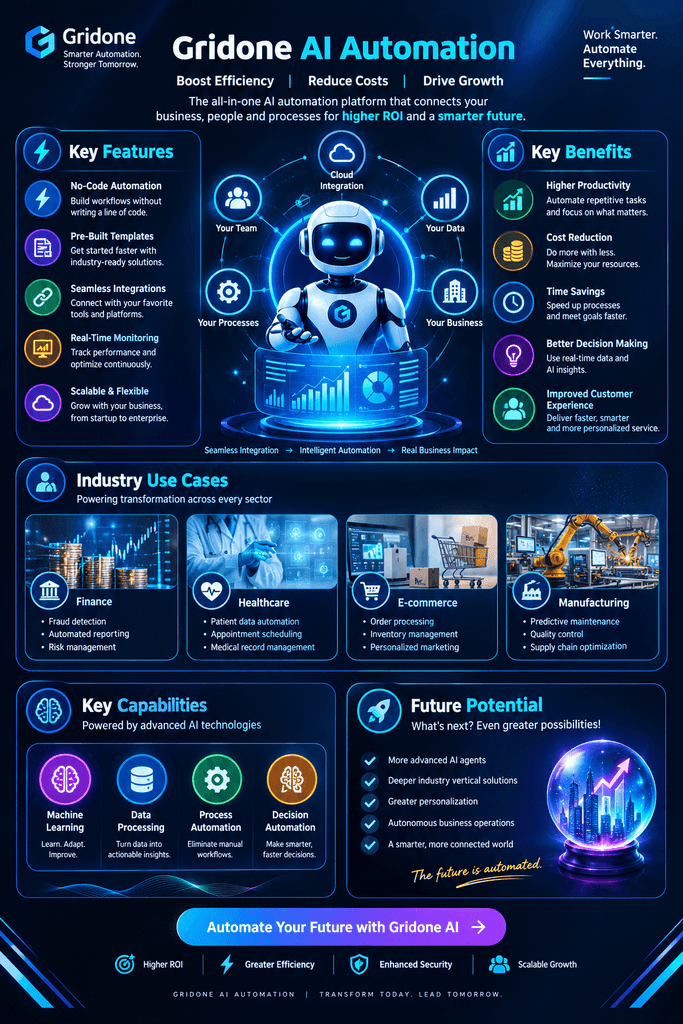
Artificial intelligence is changing how businesses manage their daily operations, process information, communicate with customers, and make decisions. From automating repetitive administrative tasks to improving data analysis, AI-powered systems are helping organizations save time and use their resources more effectively. As businesses increasingly explore intelligent automation, specialized platforms and solutions are attracting attention for their potential to simplify complex workflows.
Gridone AI automation is a topic worth exploring in the broader context of AI-driven business processes, workflow management, and digital transformation. Understanding this topic requires examining how artificial intelligence and automation work together, what capabilities an AI automation solution may offer, how organizations can evaluate its suitability, and what challenges they should consider before adopting it.
It is important to distinguish between general AI automation capabilities and verified product-specific features. Without reliable documentation confirming the exact capabilities, pricing, integrations, and technical specifications of Gridone, those details should not be assumed. This guide therefore explains the relevant concepts and practical evaluation criteria while identifying where product-specific verification is necessary.
Whether you are a business owner, digital marketer, technology enthusiast, or professional exploring intelligent workflows, this article will help you understand the principles behind gridone ai automation and how to assess its potential role in a modern business environment.
Read More: AI Automation Platform: 9 Essential Benefits, Features, Types & Applications
What Is Gridone AI Automation?
The term gridone ai automation refers to the subject of applying artificial intelligence and automated processes in connection with Gridone. However, the precise meaning depends on the particular product, company, or service identified by that name. Its official documentation should be consulted before attributing specific functions to it.
More broadly, AI automation combines software-driven task execution with artificial intelligence to reduce the amount of manual work required to complete business processes. Traditional automation follows predefined rules, whereas AI-enabled automation can also interpret information, classify content, identify patterns, and generate responses when supported by appropriate models and integrations.
For example, a conventional automation workflow might send an email whenever a customer completes a form. An AI-enhanced workflow could additionally categorize the customer’s request, summarize its contents, identify its urgency, and direct it to the appropriate team.
The difference is not simply that one system works faster. Intelligent automation can help businesses handle information that would otherwise require human interpretation, although complex or consequential decisions may still need human review.
When evaluating gridone ai automation, businesses should establish whether the solution provides workflow orchestration, AI model access, integrations with external applications, data processing, or another specialized capability. These distinctions determine its practical value.
How Does AI Automation Work?
AI automation generally operates through a sequence of connected steps. The exact implementation varies by platform, but the underlying principles are widely applicable.
1. Data Collection
The process begins when a system receives information from a user, application, database, website, document, or other source.
For example, an online business might receive customer inquiries through a contact form. The automation system collects the submitted information and prepares it for processing.
The quality of this input matters. Incomplete, inaccurate, or poorly structured information can reduce the reliability of subsequent operations.
Read More: AI Automation News: 11 Major Trends, Breakthroughs & Business Impacts in 2026
2. AI-Powered Processing
An AI model processes the information to perform a supported task. Depending on the technology used, this might involve recognizing text, extracting important details, classifying a request, summarizing a document, or generating a draft response.
Not every automation platform includes all these capabilities. Some rely on external AI services, while others provide built-in models or conventional rule-based processing.
3. Workflow Execution
After processing the information, the system performs the next action according to its configuration.
Possible actions include creating a database record, updating a customer relationship management system, assigning a support ticket, sending a notification, or preparing a report.
A well-designed workflow defines what happens when the AI produces an uncertain result, encounters missing information, or cannot complete an action.
Read More: AI Automation in Healthcare: 9 Essential Benefits, Applications, Challenges & Future Trends
4. Monitoring and Review
The final stage involves checking whether the process worked as intended. Monitoring can include execution logs, error reports, approval requests, and performance measurements.
Human oversight is especially important when an automated action could affect finances, customer relationships, confidential information, or legal obligations.
For organizations investigating gridone ai automation, understanding these four stages provides a practical starting point for determining how an actual product fits into an existing workflow.
Read More: AI Automation Solutions: 9 Essential Benefits, Types, Tools & Implementation Guide
Overview of Gridone and Its AI Automation Solutions
Gridone is a South Korean enterprise automation company whose official website describes a portfolio of technologies covering robotic process automation (RPA), artificial intelligence optical character recognition (AI OCR), retrieval-augmented generation (RAG), large language models (LLMs), and AI agents. Its stated focus includes financial institutions and public-sector organizations that need automation within controlled IT environments.
The company’s portfolio includes separate products for routine task automation, document understanding, enterprise knowledge retrieval, and AI-assisted task execution. These components can support different stages of a broader automation strategy.
A key concept behind this approach is hyperautomation: combining multiple automation technologies rather than relying on a single tool. For example, a business process might use OCR to extract information from a document, RAG to retrieve relevant internal policies, an LLM to interpret the request, and RPA or an AI agent to carry out an approved action.
The exact components required depend on the process, existing software, security requirements, and desired outcomes.
Read More: Cybersecurity AI Automation 2026: 9 Essential Trends, Benefits, Risks & Complete Guide
The Main Technologies Behind Gridone

1. AutomateOne — Robotic Process Automation
AutomateOne is Gridone’s RPA solution for automating structured, repetitive tasks. RPA can perform configured operations such as interacting with software interfaces, moving information between applications, and processing routine transactions.

2. GO AI OCR — Intelligent Document Processing
Optical character recognition converts text in scanned images and documents into machine-readable information. AI-enhanced document processing can also help identify fields, understand document layouts, and extract information from less structured files.

3. GO RAG — Enterprise Knowledge Retrieval
Retrieval-augmented generation connects an AI model to relevant source material. Gridone describes GO RAG as a solution for searching internal knowledge, including information contained in documents such as PDFs and Korean HWP files.

4. GO Automation Platform — Enterprise AI Infrastructure
The platform is described as supporting private generative AI, lightweight language models, modular components, and no-code or low-code automation development. Its stated design emphasizes adapting AI capabilities to organizational workflows.

5. GO;DO — AI Agent Service
Gridone describes GO;DO as an AI agent service that combines language models with automation tools to execute tasks through software interfaces. This extends AI beyond generating answers to performing configured actions, subject to the system’s capabilities and controls.
Together, these technologies illustrate how gridone ai automation can be understood as an enterprise automation ecosystem rather than simply a chatbot or a single-purpose AI application.
Read More: How Does AI Automation Work in Customer Support? 9 Essential Steps, Benefits, Tools & Complete Guide
Key Features of Gridone AI Automation
The value of an enterprise automation solution depends on the capabilities available, how well they work together, and how easily they fit into existing operations.
1. Automated Business Processes
One of the primary purposes of automation is to reduce repetitive manual work. RPA can execute predictable actions according to predefined instructions, allowing employees to spend less time copying information, updating records, and performing routine software operations.
For example, a finance team might use an automation workflow to collect information from an approved source, validate required fields, update an internal system, and create an exception report when the information is incomplete.
The actual workflow would need to be configured and tested for the organization’s systems.
Read More: Best GTM Digital Agents in AI Sales Automation: 9 Leading Tools and a Complete Guide
2. Natural-Language Interaction
Some modern automation platforms allow users to describe tasks in ordinary language instead of building every step manually. Gridone’s GO Automation Platform and AutomateOne AI materials describe natural-language-based automation development and AI-assisted code generation.
This approach can make automation easier to access for employees who do not have extensive programming experience. However, natural-language instructions still need to be translated into valid actions, permissions, and business rules.
Users should review generated workflows before allowing them to modify important records or execute consequential transactions.
Read More: What Is AI Automation Software? 9 Essential Facts, Benefits, Types & Applications
3. Document Recognition and Processing
Businesses often receive information through invoices, application forms, contracts, reports, scanned letters, and other documents. Manually extracting information from each file can be time-consuming.
AI OCR can help transform these documents into structured data. Depending on the document type and implementation, a workflow may extract names, dates, reference numbers, totals, or other required fields.
A practical implementation should include validation checks because poor image quality, unusual layouts, handwriting, and ambiguous content can reduce recognition accuracy.
4. Enterprise Knowledge Search
Employees frequently need information spread across internal documents, policy manuals, archived reports, and knowledge repositories.
A RAG-based system retrieves relevant material and uses it to help generate a response. This can reduce the effort required to locate information across large collections of documents.
Gridone’s GO RAG materials describe enterprise knowledge retrieval as a core use case.
Organizations should evaluate retrieval quality, source attribution, document permissions, and the system’s ability to acknowledge when relevant information cannot be found.
Read More: What Is AI Automation? A Complete Guide to How It Works, Benefits, Types, and Applications
5. AI Agent Task Execution
An AI agent combines reasoning or language-model capabilities with tools that allow it to perform actions. Rather than only explaining how a task should be completed, an appropriately configured agent may interact with software to carry out selected steps.
Gridone’s GO;DO service is designed around this concept, using language models and automation components to interact with applications and execute tasks.
Agent-based workflows require especially careful design. Access permissions, action limits, approval requirements, and recovery procedures help reduce the consequences of unexpected behavior.
Read More: Zapier Updates News: 5 Latest Features, Improvements, and What They Mean for Users
6. Private and On-Premises Deployment
Data protection is a major concern for organizations handling confidential business information. Gridone describes on-premises deployment as a core part of its enterprise AI approach, with cloud and hybrid environments also available through separate arrangements.
On-premises deployment can give an organization greater control over where its systems and data are hosted. Nevertheless, it does not automatically guarantee security. Access management, encryption, patching, network protection, monitoring, and appropriate operational procedures remain necessary.
Read More: What Are the Best AI Workflow Automation Tools? Top Solutions for Smarter Business Processes
7. Modular Implementation
A modular approach allows businesses to select technologies according to their needs rather than introducing every capability simultaneously.
For example, an organization might begin with document recognition, then add internal knowledge search, and later connect these functions to automated workflows. Gridone’s published platform materials describe a modular collection of automation components.
This staged approach can make it easier to test business value, manage implementation risks, and prioritize the processes with the strongest potential returns.
Read More: 7 Essential and Effective Insights on How Google Determines Search Relevance
Benefits of Gridone AI Automation for Businesses
The benefits of an enterprise automation solution depend on the process being automated, the quality of its implementation, and the resources required to maintain it. The following are potential advantages of the technologies described above, rather than guaranteed results for every organization.
Improved Operational Efficiency
Automation can reduce the number of manual steps required to complete repetitive tasks. Employees may spend less time entering the same information into multiple systems or searching through documents for routine answers.
When several tasks are connected into a single workflow, organizations may also reduce delays caused by handoffs between departments.
Read More: What Is SEO Rank Tracking? A Complete Guide to Measuring Search Performance
Lower Administrative Workloads
Repetitive data entry, document classification, record updates, and routine report preparation can consume significant staff time.
Automating suitable activities allows employees to concentrate on work requiring judgment, communication, planning, and specialist knowledge. Savings should be measured against the total cost of implementation, licensing, infrastructure, and maintenance.
Read More: Do Google Reviews Help SEO? A Clear, Practical Guide to Rankings and Trust
Greater Consistency
Human operators may use different methods when performing the same repetitive task. A properly configured automation workflow can apply consistent rules and validation checks.
Consistency is particularly useful in structured processes such as document routing, standard record updates, and routine compliance checks. It does not eliminate errors, because incorrect rules or unreliable AI outputs can also be repeated systematically.
Read More: What Is Off-Page SEO? A Complete Guide to Building Authority and Trust
Faster Access to Internal Information
Enterprise knowledge retrieval can make it easier for employees to find relevant information without manually opening numerous documents.
For example, a staff member might ask an internal system to locate the policy governing a particular procedure. A suitable RAG implementation can retrieve relevant passages and prepare a concise response.
The benefit depends on document coverage, retrieval accuracy, permissions, and how recently the knowledge base has been updated.
Read More: How SEO Marketing Works – A Clear Guide to Traffic, Rankings, and Conversions
Support for Business Growth
As organizations expand, transaction volumes, document collections, and customer requests often increase. Automation can help process additional work without requiring every task to be handled manually.
However, scalability depends on available computing resources, software licensing, integration limits, workflow complexity, and the need for human review.
Better Use of Employee Skills
Automation works best when it removes unnecessary effort without removing meaningful human responsibility. Employees can redirect their attention toward customer relationships, exception handling, strategic planning, and quality improvement.
In this way, gridone ai automation can be evaluated as a potential tool for redesigning work, not merely as a means of replacing individual manual actions.
Read More: What Is Google SEO? Clearly Explained Guide With Tools & Tips
Practical Use Cases of Gridone AI Automation
The usefulness of an automation platform becomes clearer when its capabilities are connected to specific business challenges. Gridone’s published materials identify applications involving document processing, enterprise knowledge retrieval, automated software testing, and AI-assisted business operations.
1. Banking and Financial Services
Financial institutions process large volumes of documents, customer requests, transaction records, and compliance-related information. Many of these activities involve repetitive procedures and strict documentation requirements.
An automation workflow could extract information from submitted documents, compare required fields against predefined rules, and route incomplete applications to the appropriate employee.
An AI-powered knowledge system could also help authorized staff locate internal policies and procedural guidance.
However, decisions involving credit approval, fraud investigations, financial transfers, or regulatory obligations require appropriate controls and human oversight. Automated extraction or classification should not be treated as definitive proof that a transaction is legitimate.
Read More: Do No Follow Links Help SEO?
2. Government and Public-Sector Organizations
Public institutions often manage applications, official correspondence, policy documents, administrative records, and citizen inquiries.
Document processing can help digitize incoming paperwork, while enterprise search can make internal information easier to locate. RPA can then transfer approved information between compatible systems.
For instance, an application-processing workflow could recognize a submitted form, extract relevant fields, identify missing information, and direct the application to the correct department.
This type of process can reduce unnecessary manual handling while preserving established review and approval procedures.
Read More: How Many Keywords Should I Use for SEO?
3. Legal and Compliance Work
Legal departments frequently need to search extensive document collections and prepare summaries of contracts, regulations, policies, and case-related materials.
A properly configured knowledge retrieval system can help locate relevant passages and produce preliminary summaries. AI may also assist with preparing first drafts of reports or structured documents.
Gridone’s published GO Automation Platform materials identify legal-document drafting and related enterprise workflows among its use cases.
Nevertheless, AI-generated legal content should be checked against authoritative sources. A qualified professional should review important interpretations, contractual language, and compliance decisions before they are used.
4. Customer Service and Internal Support
Customer support teams often handle recurring questions about products, procedures, account services, and troubleshooting.
An AI-assisted workflow can classify incoming requests, retrieve relevant support documentation, prepare a response, and assign complex cases to a human representative.
Internal IT support can use a similar approach to help employees locate troubleshooting instructions or submit service requests.
The system should distinguish between routine informational questions and issues that require specialist intervention. It should also avoid exposing private customer information to unauthorized users.
Read More: How Many Internal Links Per Page SEO: A Complete Informational Guide
5. Software Testing and Quality Assurance
Software development teams must repeatedly test applications after updates, configuration changes, and new feature releases.
Automated testing tools can execute predefined tests, compare actual results with expected behavior, and report failures. AI can potentially help with test generation, test maintenance, or analysis of failure information.
Gridone’s portfolio includes TestOne and AI-assisted software engineering capabilities, reflecting its focus on software testing and development-related automation.
Human engineers remain important for assessing whether tests cover the right requirements, interpreting unusual failures, and verifying that automated checks are meaningful.
Read More: What Is Local SEO? A Complete Guide to Boosting Your Local Visibility
6. Document-Heavy Administrative Departments
Human resources, procurement, accounting, and operations teams frequently handle repetitive document-based activities.
Consider a procurement department receiving supplier documents. An automated workflow might:
- Identify the incoming document type.
- Extract supplier details and reference numbers.
- Check whether required fields are present.
- Compare information against approved records.
- Route discrepancies for review.
- Save validated information in the relevant system.
This example illustrates how document recognition, business rules, and software automation can work together. Whether a particular Gridone product supports the complete workflow depends on its configuration and the organization’s existing applications.
Read More: What Are Citations in SEO?
How to Implement Gridone AI Automation Successfully
Adopting an automation platform is not simply a matter of installing software. Successful implementation requires clear objectives, reliable data, suitable infrastructure, and an ongoing process for measuring results.
Step 1: Identify a Suitable Business Process
Start by identifying a process that consumes significant time, follows reasonably clear rules, and produces measurable results.
Examples include routine data entry, document classification, internal knowledge searches, and report preparation.
Avoid beginning with a highly complex process that depends on uncertain information, numerous exceptions, and sensitive decisions. A smaller initial project makes it easier to assess the technology before expanding its use.
Step 2: Document the Existing Workflow
Record how the selected process works today.
Identify its inputs, outputs, responsible employees, applications, approval stages, common errors, and average completion time. Documenting the existing workflow helps reveal unnecessary steps and integration requirements.
Without this baseline, it becomes difficult to determine whether automation has genuinely improved performance.
Step 3: Select the Appropriate Technology
Different problems require different tools.
| Business requirement | Relevant technology |
|---|---|
| Repetitive software interactions | RPA |
| Extracting text from scanned documents | AI OCR |
| Searching internal documents | RAG |
| Generating or interpreting text | LLM |
| Performing multi-step tasks through software | AI agents |
| Repeated software verification | Automated testing |
A solution may combine several technologies, but using more components than necessary can increase complexity and cost.
Step 4: Check Integration and Infrastructure Requirements
Before implementation, confirm that the proposed solution can work with the organization’s existing applications, databases, identity systems, and document repositories.
Determine whether the required integrations are available directly, through APIs, through desktop interaction, or through custom development.
Gridone’s product materials describe on-premises enterprise deployment and modular automation capabilities, but the precise infrastructure, compatibility, and integration arrangements should be confirmed for the intended project.
Step 5: Establish Security and Governance Controls
Define which users and systems can access the automation environment. Establish rules for sensitive data, model access, logging, retention, and approval requirements.
For workflows that modify records or trigger financial or operational actions, use safeguards such as restricted permissions, validation rules, and approval checkpoints.
AI agents should operate within explicitly defined boundaries. A system should not receive unrestricted access simply because it can execute tasks autonomously.
Step 6: Run a Pilot Project
Test the proposed workflow using representative data and realistic operating conditions.
Measure processing time, error rates, exceptions, human-review requirements, and operational costs. Include unusual cases rather than testing only straightforward examples.
A pilot can also reveal whether the system is easy for employees to use and whether the proposed workflow needs redesign.
Step 7: Evaluate and Expand
Compare the pilot results with the original baseline. If the project demonstrates meaningful benefits, consider extending the approach to additional workflows.
Expansion should follow the evidence. A successful document-processing pilot does not automatically prove that the same technology will work equally well for customer support, software testing, or complex decision-making.
Read More: What Is White Label SEO?
Potential Challenges and Limitations
Although gridone ai automation relates to technologies with substantial business potential, organizations should evaluate their limitations before making an investment.
Implementation Complexity
Connecting AI, document-processing systems, legacy applications, and automated workflows may require technical expertise. Older applications can introduce additional challenges when they lack suitable APIs or consistent data formats.
A realistic implementation plan should include integration testing, staff training, and ongoing maintenance.
Read More: How Do Companies Create a Post Calendar for SEO?
AI Accuracy and Reliability
AI systems can misinterpret documents, generate unsupported statements, or classify unusual cases incorrectly. OCR errors can also affect downstream processing.
Organizations should use validation rules, confidence thresholds where available, exception handling, and human review for important decisions.
Data Privacy and Cybersecurity
Enterprise automation may process personal information, confidential records, financial documents, and internal business knowledge.
Organizations must evaluate data storage, access controls, encryption, vendor arrangements, and applicable privacy requirements. On-premises deployment may help meet certain data-residency and network-isolation needs, but it is not a substitute for a complete security program.
Read More: How Can an AI Search Monitoring Platform Improve SEO Strategy?
Maintenance and Changing Processes
Business rules, application interfaces, document formats, and regulatory requirements change over time. An automation workflow that works today may require updates later.
Maintenance costs should therefore be included in the overall business case.
Employee Training and Adoption
Employees may need training to understand how to operate automation tools, review AI-generated content, handle exceptions, and report problems.
Clear communication is also important. Automation should have defined responsibilities and escalation procedures so that staff know when to trust a result, when to verify it, and when to intervene.
Read More: How to Rank With Video SEO: 27 Proven Positive Power Strategies for Explosive Growth
Cost and Return on Investment
The total cost of ownership may include licensing, infrastructure, implementation, integrations, training, monitoring, and maintenance.
Businesses should avoid judging a solution solely by the number of tasks it can automate. The more important question is whether the complete system delivers measurable value after all costs and risks are considered.
Read More: How to Use Google Analytics for SEO: 21 Powerful and Positive Strategies That Actually Work
How to Measure the Success of an AI Automation Project
A successful implementation should demonstrate improvements that can be measured over time.
Useful performance indicators include:
- Processing time: How long does each task take before and after implementation?
- Error rate: How often does the workflow produce incorrect or incomplete results?
- Automation coverage: What proportion of eligible cases can be completed without manual intervention?
- Exception rate: How frequently must employees intervene?
- Operating cost: What are the total costs per completed task?
- Employee productivity: How much time is redirected toward higher-value activities?
- User satisfaction: Do employees find the system reliable and practical?
- Security performance: Are access controls, audit requirements, and incident procedures functioning as intended?
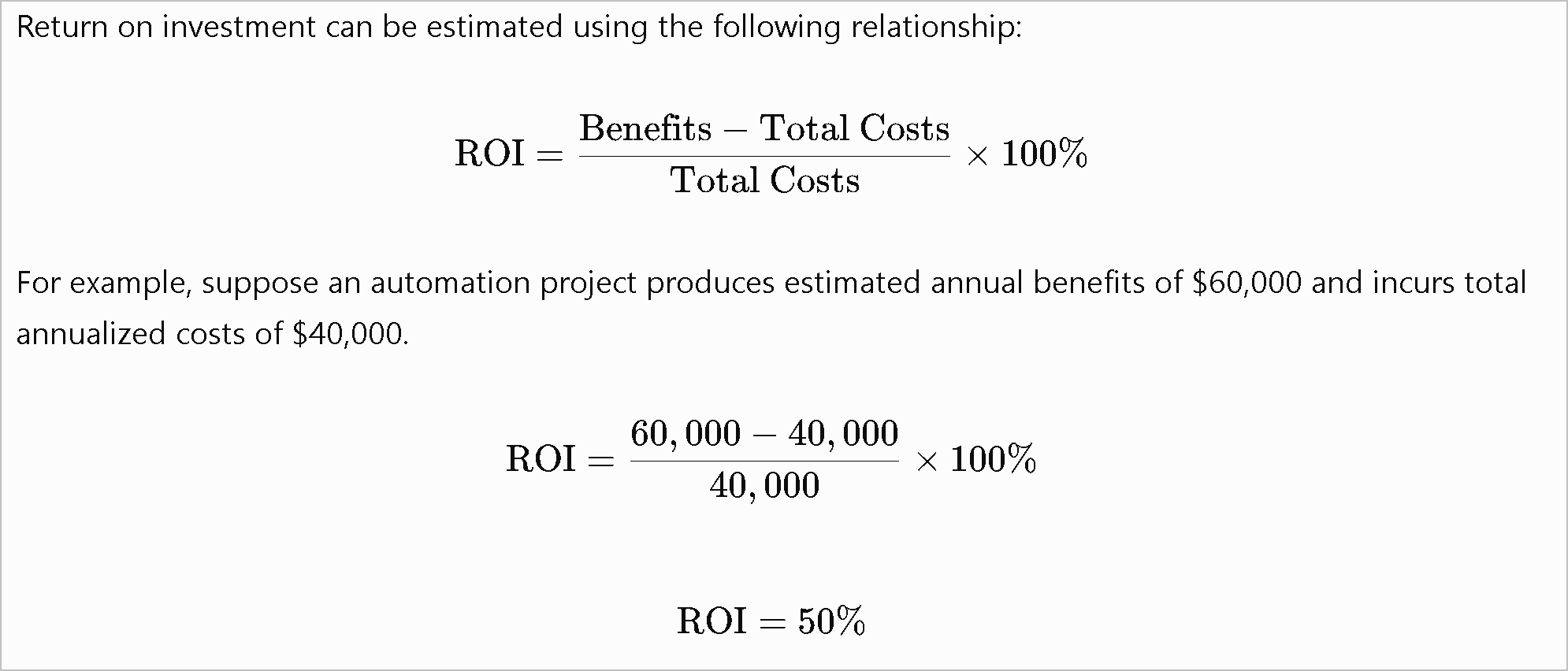
These figures are illustrative, not reported results for Gridone. A real assessment should use measured savings, implementation expenses, maintenance costs, and other relevant financial effects.
Read More:How to Measure SEO in Google Analytics: 21 Powerful & Proven Ways for Positive Growth
Gridone AI Automation vs. Traditional Automation
Traditional automation and AI-powered automation solve overlapping but different problems.
| Comparison | Traditional automation | AI-powered automation |
|---|---|---|
| Primary method | Predefined rules and instructions | Rules combined with AI capabilities |
| Structured tasks | Generally well suited | Well suited when appropriately configured |
| Unstructured documents | Often requires additional processing | Can use OCR and document understanding |
| Natural-language interpretation | Usually limited without additional components | Possible with suitable language models |
| Predictability | Often high for stable, defined processes | Depends on the model, inputs, and controls |
| Human oversight | Needed for exceptions and important actions | Needed for exceptions, uncertainty, and consequential decisions |
The distinction is not absolute. Traditional RPA can be highly effective, while AI-powered workflows often rely on traditional automation to execute actions reliably.
Gridone’s portfolio reflects this combination of technologies, bringing together RPA, document processing, language models, enterprise search, and agent-based task execution.
Read More: What Is Duplicate Content and How to Fix It for Better SEO
Future Potential of Gridone AI Automation
Enterprise automation is evolving from isolated, rule-based scripts toward connected systems that can interpret information, retrieve knowledge, coordinate workflows, and execute selected actions.
Several developments are particularly relevant.
More Capable AI Agents
AI agents may increasingly handle multi-step workflows by selecting tools, gathering information, and executing actions within defined boundaries.
The challenge will be making these systems reliable, auditable, secure, and economical enough for everyday business operations.
Better Document Understanding
Advances in document processing may improve the handling of complex tables, scanned records, mixed document formats, and information spread across multiple pages.
This could make automation more practical for organizations that still rely heavily on paperwork and legacy records.
Greater Integration With Enterprise Knowledge
Combining retrieval systems with language models can help employees access relevant internal information when performing routine tasks.
Future improvements will depend not only on model quality but also on document freshness, permissions, retrieval accuracy, and the ability to provide trustworthy references.
Human and AI Collaboration
The most practical future for business automation is unlikely to involve eliminating human involvement from every process.
Instead, AI may handle predictable steps and prepare recommendations while employees focus on judgment, exception handling, relationships, and accountability.
For Gridone and other enterprise automation providers, the long-term opportunity lies in making these capabilities work together without introducing unnecessary complexity or risk.
Frequently Asked Questions (FAQ)
1. What is Gridone AI automation?
Gridone ai automation refers to Gridone’s enterprise automation technologies and their application to business processes. Gridone is a South Korean company with solutions covering RPA, AI OCR, enterprise knowledge retrieval, generative AI platforms, and AI agents.
2. Is Gridone an AI automation company?
Yes. Gridone describes itself as an enterprise automation specialist and offers technologies for robotic process automation, document processing, AI platforms, and AI agent services. Its official website highlights its experience serving financial and public-sector organizations.
3. What is the GO Automation Platform?
GO Automation Platform is Gridone’s enterprise generative AI automation platform. Its published features include private AI infrastructure, modular automation components, lightweight language models, and no-code or low-code development capabilities.
4. What is the difference between AutomateOne and GO;DO?
AutomateOne focuses on robotic process automation and related automation development. GO;DO is described as an AI agent service that combines language models and automation tools to perform tasks through software interfaces.
5. Can Gridone automate document processing?
Gridone offers GO AI OCR for document recognition and data extraction. Its portfolio also includes GO RAG for searching enterprise knowledge. The exact document types, extraction capabilities, integrations, and accuracy should be confirmed for the intended use case.
6. Is Gridone suitable for small businesses?
It may be suitable for some smaller organizations, but suitability depends on the business process, implementation requirements, available infrastructure, budget, and support needs. Because the published portfolio emphasizes enterprise and regulated-sector use cases, smaller businesses should request a demonstration and a project-specific cost estimate before making a decision.
7. Does Gridone support on-premises deployment?
Yes. Gridone’s official materials describe on-premises deployment as a core approach for its enterprise automation solutions. Cloud and hybrid arrangements may also be available depending on the solution and deployment agreement.
8. Does AI automation eliminate the need for employees?
No. AI automation can reduce repetitive work and support certain decision-making activities, but it does not eliminate the need for human judgment, accountability, exception handling, and quality assurance. Organizations should define which tasks can be automated and which require human approval.
9. How can a business get started with Gridone?
A business can begin by identifying a suitable process, documenting its requirements, and contacting Gridone through its official website. Request a product demonstration, technical compatibility assessment, security documentation, and a pilot proposal before committing to a larger implementation. Visit the official Gridone website for product information and contact options.
10. How should a business evaluate the return on investment?
Compare the costs of implementation, licensing, infrastructure, training, and maintenance with measurable improvements in processing time, error rates, employee workload, and operational expenses. Use a pilot project to establish realistic results before estimating the benefits of a wider rollout.
Conclusion
Artificial intelligence is expanding the possibilities of business automation by combining software execution with document understanding, knowledge retrieval, and language-based reasoning. Gridone’s portfolio illustrates this approach through technologies such as AutomateOne, GO AI OCR, GO RAG, GO Automation Platform, and GO;DO.
The potential benefits include more efficient workflows, easier access to internal information, consistent processing of routine tasks, and improved use of employee time. However, these benefits depend on careful implementation, reliable integrations, data protection, human oversight, and measurable business objectives.
Organizations exploring gridone ai automation should begin with a clearly defined problem rather than adopting AI simply because it is available. By evaluating the relevant products, testing a realistic workflow, and measuring the results, businesses can determine whether Gridone’s automation capabilities offer a practical and sustainable solution for their needs.