
AI Automation Tools for Manufacturing: A Complete Guide to 9 Essential Technologies, Benefits, and Applications
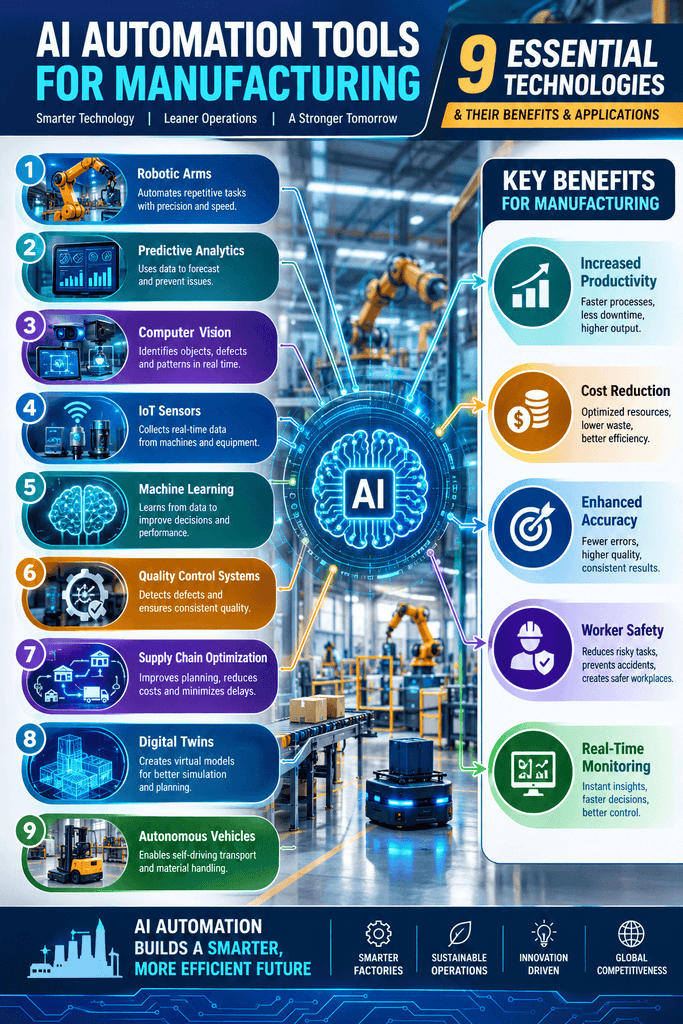
Manufacturing industries are undergoing a major transformation as artificial intelligence (AI), robotics, machine learning, and industrial automation become increasingly important. Traditional manufacturing processes often depend on manual inspections, scheduled maintenance, and human decision-making. Although these methods have supported industrial production for decades, they can struggle to meet modern demands for speed, accuracy, flexibility, and cost efficiency.
Today, manufacturers are adopting ai automation tools for manufacturing to improve production processes, reduce operational expenses, maintain consistent product quality, and make better use of industrial data. These technologies combine intelligent software, connected machines, sensors, and automated systems to help factories operate more efficiently.
From identifying equipment failures before they occur to optimizing production schedules and detecting defects on assembly lines, AI-powered solutions can support many manufacturing activities. They can also help manufacturers respond to changing customer demands, manage supply chains, and improve workplace safety.
However, implementing these technologies requires careful planning. Manufacturers must consider their existing equipment, production goals, workforce capabilities, cybersecurity requirements, and available budgets before selecting an appropriate solution.
This article explains the major categories of AI automation technology, their benefits, practical applications, popular platforms, implementation strategies, challenges, and future potential.
Read More: Gridone AI Automation: A Complete Guide to Features, Benefits, Use Cases, and Future Potential
What Are AI Automation Tools for Manufacturing?
AI automation tools for manufacturing are software applications, intelligent machines, and integrated technological systems that use artificial intelligence to automate, analyze, or improve industrial operations.
Unlike conventional automation systems that follow predefined instructions, AI-enabled solutions can analyze data, recognize patterns, make predictions, and adapt their recommendations to changing conditions. Depending on their design, some systems can also adjust processes automatically within predefined safety limits.
For example, a conventional monitoring system may activate an alarm when a machine exceeds a specified temperature. An AI-based predictive maintenance system can analyze temperature changes, vibration measurements, operating hours, and historical failures to estimate whether the machine is likely to develop a problem.
This difference helps manufacturers move from reactive problem-solving toward proactive and data-driven operations.
Read More: AI Automation Platform: 9 Essential Benefits, Features, Types & Applications
How Do These Tools Work?
Most intelligent manufacturing systems rely on several interconnected components.
1. Data collection: Sensors, cameras, programmable logic controllers (PLCs), and industrial equipment collect information about temperature, pressure, vibration, production speed, and product quality.
2. Data processing: Software organizes the collected information and prepares it for analysis.
3. AI analysis: Machine learning models and other analytical techniques identify patterns, detect unusual behavior, predict potential problems, or recommend improvements.
4. Decision-making: The system produces alerts, recommendations, forecasts, or optimized operating parameters.
5. Automated action: Where appropriate and properly validated, the system sends approved commands to connected equipment or automation software.
6. Continuous evaluation: Manufacturers monitor performance and update models as production conditions change.
The exact workflow depends on the application. Some systems only provide recommendations, while others can control selected processes through carefully designed industrial control architectures.
9 Essential Types of AI Automation Tools for Manufacturing
1. Predictive Maintenance Software
Equipment failure can interrupt production, increase repair expenses, delay deliveries, and create safety risks. Predictive maintenance software helps manufacturers identify possible equipment problems before they result in unexpected breakdowns.
These solutions analyze information such as vibration, temperature, pressure, electrical current, lubrication conditions, and maintenance history. Machine learning algorithms can identify patterns associated with wear, overheating, imbalance, or other developing faults.
For example, a factory operating several industrial motors may use vibration sensors to monitor their condition. If the software detects an unusual vibration pattern, it can notify maintenance personnel and recommend an inspection before the motor fails.
Common capabilities include:
- Real-time equipment condition monitoring.
- Failure prediction and anomaly detection.
- Maintenance scheduling recommendations.
- Remaining useful life estimation.
- Maintenance history and performance reporting.
Platforms such as IBM Maximo Application Suite, Siemens industrial software, and PTC ThingWorx support different aspects of asset monitoring, industrial analytics, or maintenance management.
The most suitable option depends on the manufacturer’s equipment, data availability, integration requirements, and maintenance strategy.
Read More: AI Automation News: 11 Major Trends, Breakthroughs & Business Impacts in 2026
2. AI-Powered Quality Inspection Systems
Product quality is essential for customer satisfaction, regulatory compliance, and manufacturing profitability. Traditional inspection methods may require workers to examine products individually, which can be time-consuming and inconsistent when production volumes are high.
AI-powered visual inspection systems use industrial cameras, image-processing software, and computer vision models to identify defects. Depending on the application, they can detect scratches, cracks, incorrect assembly, missing components, surface irregularities, and dimensional inconsistencies.
For instance, an electronics manufacturer can install cameras above a production line to inspect circuit boards. An AI model trained on representative images may identify soldering defects or missing components and flag suspicious products for further inspection.
Important features include:
- Automated defect detection.
- Image-based product classification.
- Real-time inspection during production.
- Defect tracking and reporting.
- Integration with production and quality management systems.
Companies such as Cognex and Keyence offer industrial vision technologies, while other machine vision platforms provide AI-based inspection capabilities.
Manufacturers should validate inspection systems against actual production samples, including rare defects and changing lighting conditions. Human review may remain necessary for uncertain cases or high-risk decisions.
Read More: AI Automation in Healthcare: 9 Essential Benefits, Applications, Challenges & Future Trends
3. Intelligent Industrial Robotics
Industrial robots have long been used for welding, painting, material handling, packaging, and assembly. AI can improve these applications by helping robots interpret sensor information, recognize objects, adjust movements, and perform tasks in more variable environments.
AI-enabled robotics may combine machine vision, motion planning, force sensing, and machine learning. These capabilities can help robots identify components in different positions or adjust their actions when materials are not perfectly aligned.
For example, a robot equipped with a vision system can locate randomly positioned parts on a conveyor belt and select them for assembly. Another application involves collaborative robots that assist workers with repetitive material-handling tasks.
Leading industrial robotics suppliers include FANUC, ABB, Yaskawa, and Universal Robots. The availability of AI capabilities varies by model, software package, and integration.
Potential applications include:
- Robotic assembly and fastening.
- Welding and surface finishing.
- Component sorting and picking.
- Machine tending.
- Palletizing and packaging.
- Automated material handling.
Robotic automation can improve repeatability and reduce workers’ exposure to certain hazardous tasks. However, safe deployment requires risk assessment, suitable guarding or collaborative safety features, operator training, and compliance with applicable industrial safety standards.
Read More: AI Automation Solutions: 9 Essential Benefits, Types, Tools & Implementation Guide
4. Production Planning and Scheduling Software
Manufacturing operations involve coordinating raw materials, machines, labor, inventory, delivery deadlines, and production orders. Poor scheduling can create bottlenecks, excessive waiting time, and unnecessary machine changeovers.
AI-enabled planning systems analyze production data to help manufacturers allocate resources and determine suitable production sequences.
For example, a factory producing several product variations may use intelligent scheduling software to group similar jobs, reduce equipment changeovers, and account for material availability. If a machine becomes unavailable, the system may recommend an alternative schedule.
Useful capabilities include:
- Production demand forecasting.
- Capacity planning.
- Resource allocation.
- Bottleneck identification.
- Production sequence optimization.
- Schedule adjustment based on changing conditions.
Platforms such as Siemens Opcenter and advanced planning solutions from other industrial software providers can support production planning and scheduling. Some implementations incorporate AI, while others primarily use optimization algorithms, rules, and mathematical modeling.
Manufacturers should evaluate how a platform handles real production constraints rather than relying only on its advertised AI features.
Read More: Cybersecurity AI Automation 2026: 9 Essential Trends, Benefits, Risks & Complete Guide
5. Industrial Internet of Things (IIoT) Platforms
The Industrial Internet of Things connects machines, sensors, controllers, and software systems so that manufacturers can monitor operations and analyze production data.
An IIoT platform can collect information from equipment across a factory and make it available for dashboards, alerts, analytics, and AI applications.
For example, a manufacturer operating multiple production lines may use connected sensors to compare machine utilization, energy consumption, production speed, and downtime. AI analytics can then help identify recurring inefficiencies or unusual operating conditions.
Common capabilities include:
- Equipment connectivity and data collection.
- Real-time production monitoring.
- Industrial dashboards and alerts.
- Edge computing and cloud integration.
- Historical data analysis.
- Integration with AI and machine learning applications.
Examples include PTC ThingWorx, Siemens Industrial Edge technologies, and Microsoft Azure IoT services and related industrial solutions. Specific product names, availability, and capabilities should be checked against current vendor documentation.
An effective IIoT deployment depends on reliable connectivity, consistent data definitions, suitable sensor placement, and secure communication between operational technology and business systems.
Read More: How Does AI Automation Work in Customer Support? 9 Essential Steps, Benefits, Tools & Complete Guide
6. Digital Twin Technology
A digital twin is a digital representation of a physical asset, process, or system that can be updated using information from the real world. Depending on its design, it may support simulation, monitoring, engineering analysis, and predictive optimization.
AI can enhance a digital twin by identifying patterns in operational data, estimating future performance, or evaluating possible process adjustments.
For example, a manufacturer developing a new production line can simulate equipment placement, material movement, and production capacity before making expensive physical changes. After installation, operational data can help compare actual performance with the original model.
Digital twins can be used for:
- Equipment performance analysis.
- Production line simulation.
- Process optimization.
- Product design and testing.
- Energy and resource planning.
- Scenario analysis and troubleshooting.
Siemens, Dassault Systèmes, and other industrial technology providers offer digital twin-related solutions.
Not every digital twin includes AI, and a simulation model is not automatically a continuously updated digital twin. Manufacturers should determine whether a proposed solution supports the specific data connections and analytical functions they require.
Read More: Best GTM Digital Agents in AI Sales Automation: 9 Leading Tools and a Complete Guide
7. AI-Based Supply Chain and Inventory Management
Manufacturers depend on reliable supplies of raw materials, components, packaging, and spare parts. Unexpected demand changes, supplier delays, and inventory shortages can disrupt production and increase costs.
AI-supported supply chain systems analyze historical orders, market trends, lead times, supplier performance, inventory levels, and other relevant information to improve planning.
For example, a manufacturer may use demand forecasting software to estimate the quantity of a component needed during the next production cycle. The system can help planners identify potential shortages and adjust purchasing decisions.
Major functions include:
- Demand forecasting.
- Inventory optimization.
- Supplier risk analysis.
- Procurement planning.
- Logistics coordination.
- Identification of possible supply disruptions.
Enterprise platforms such as SAP and Oracle provide supply chain planning capabilities, with specific AI features varying by product and configuration.
These systems are most useful when the underlying information is timely and reliable. Sudden market changes, incomplete supplier records, or inaccurate lead-time estimates can reduce forecasting accuracy.
Read More: What Is AI Automation Software? 9 Essential Facts, Benefits, Types & Applications
8. Energy Management and Process Optimization Tools
Energy is a significant operating expense in many manufacturing sectors, particularly those involving furnaces, compressors, refrigeration, pumps, and other energy-intensive equipment.
AI-based energy management solutions analyze electricity consumption, equipment operating patterns, production schedules, and environmental conditions to identify opportunities for improvement.
For example, an industrial facility may use energy analytics to identify compressors that consume excessive electricity during low-demand periods. The system can recommend adjustments to operating schedules or equipment settings.
Potential applications include:
- Energy consumption forecasting.
- Detection of abnormal energy use.
- Equipment efficiency monitoring.
- Production energy optimization.
- Emissions and resource tracking.
- Identification of avoidable operating losses.
Schneider Electric, Siemens, and other industrial technology providers offer energy management and optimization solutions, although the exact AI capabilities vary.
Energy-saving recommendations should be evaluated alongside production quality, equipment reliability, and safety. Reducing energy consumption is not beneficial if the change compromises product specifications or creates an operational hazard.
Read More: Zapier Updates News: 5 Latest Features, Improvements, and What They Mean for Users
9. AI-Enabled Manufacturing Execution Systems
A manufacturing execution system (MES) helps manage and monitor production activities on the factory floor. It can connect production orders, materials, operators, equipment, quality records, and manufacturing performance.
AI-enabled MES environments can use production data to identify bottlenecks, detect unusual patterns, estimate completion times, and support decisions about resource allocation.
For instance, a factory manager may use an MES dashboard to compare planned production with actual output. Analytics can help reveal whether delays are associated with machine downtime, material shortages, extended changeovers, or quality problems.
Typical functions include:
- Production tracking.
- Work order management.
- Quality data collection.
- Traceability and batch records.
- Performance monitoring.
- Integration with enterprise resource planning systems.
Platforms such as Siemens Opcenter and other manufacturing execution solutions support different combinations of production management and analytics.
AI is not a replacement for accurate production records or effective manufacturing procedures. It works best when integrated with reliable operational data and clear decision-making processes.
Read More: What Are the Best AI Workflow Automation Tools? Top Solutions for Smarter Business Processes
Major Benefits of AI Automation in Manufacturing
The adoption of ai automation tools for manufacturing can improve industrial performance when the technologies address clearly defined operational problems. The benefits vary by industry, implementation quality, and the maturity of existing processes.
1. Increased Productivity
Intelligent systems can reduce repetitive manual work, identify production bottlenecks, and support more effective equipment utilization. Automated inspection and machine monitoring may also help production teams identify problems earlier.
As a result, manufacturers can improve throughput without necessarily increasing factory space or adding the same proportion of additional labor.
2. Reduced Operational Costs
Predictive maintenance can help reduce certain unplanned repair expenses, while production optimization may limit material waste, unnecessary machine operation, and avoidable downtime.
However, savings should be measured against software licensing, equipment upgrades, integration, training, and ongoing maintenance costs.
3. Improved Product Quality
AI inspection systems can apply consistent evaluation criteria across large volumes of products. They can also help identify recurring defect patterns and provide information that engineers can use to improve production processes.
Their performance depends on representative training data, appropriate inspection conditions, and ongoing validation.
Read More: 7 Essential and Effective Insights on How Google Determines Search Relevance
4. Reduced Equipment Downtime
Condition monitoring and predictive analytics can alert maintenance teams to developing problems. This gives manufacturers more opportunities to schedule inspections or repairs during planned downtime.
Predictions are estimates rather than guarantees, so critical equipment still requires appropriate maintenance procedures and safety checks.
5. Better Decision-Making
Manufacturing managers often work with large amounts of information from machines, suppliers, production systems, and quality records. AI analytics can help convert this information into useful forecasts, alerts, and recommendations.
Human expertise remains important when evaluating unusual situations, conflicting objectives, and high-impact operational decisions.
Read More: What Is SEO Rank Tracking? A Complete Guide to Measuring Search Performance
6. Improved Workplace Safety
Automation can reduce the need for workers to perform certain repetitive, heavy, or hazardous activities. AI-supported monitoring may also help identify abnormal machine conditions or process risks.
Nevertheless, automation introduces its own hazards. A comprehensive safety assessment is essential before introducing robots, autonomous equipment, or AI-driven control functions.
7. Greater Production Flexibility
Intelligent robotics, adaptive scheduling, and automated inspection can help factories respond to product variations and changing demand.
This flexibility can be particularly valuable for manufacturers producing smaller batches or customized products, although reconfiguration and validation may still require considerable effort.
Read More: Do Google Reviews Help SEO? A Clear, Practical Guide to Rankings and Trust
8. Better Inventory Management
Forecasting and planning tools can help manufacturers balance inventory availability against storage costs. More accurate information about demand, supplier lead times, and production requirements can reduce the likelihood of shortages or excessive stock.
9. Stronger Resource Efficiency
Energy analytics, process monitoring, and waste detection can help manufacturers use materials, water, electricity, and other resources more efficiently.
The actual environmental benefit should be assessed using measured resource consumption and production output rather than software claims alone.
Read More: What Is Off-Page SEO? A Complete Guide to Building Authority and Trust
Practical Applications Across Manufacturing Industries
Different manufacturing sectors use intelligent automation to address different operational requirements.
Automotive Manufacturing
Automotive factories can use AI-assisted robots for assembly, machine vision for defect detection, and predictive maintenance for production equipment. Connected systems may also help coordinate material delivery and improve production planning.
Electronics Manufacturing
Electronics producers can apply computer vision to circuit board inspection, automated systems to component placement, and analytics to monitor process consistency. Precision and traceability are especially important because some defects are difficult to detect without specialized inspection techniques.
Read More: What Is Local SEO? A Complete Guide to Boosting Your Local Visibility
Food and Beverage Manufacturing
Food manufacturers can use automated inspection, temperature monitoring, production scheduling, and predictive maintenance. Systems must also support relevant hygiene, food safety, traceability, and regulatory requirements.
Pharmaceutical Manufacturing
Pharmaceutical facilities may use automated process monitoring, equipment condition analysis, electronic production records, and quality analytics. Any AI application affecting regulated manufacturing decisions must be appropriately validated and controlled.
Read More: How SEO Marketing Works – A Clear Guide to Traffic, Rankings, and Conversions
Metal and Heavy Industries
Steel plants, foundries, and metal fabrication facilities can apply predictive maintenance to heavy machinery, machine vision to inspect surfaces, and process analytics to monitor temperature, pressure, and material quality.
Textile and Garment Manufacturing
Textile producers can use visual inspection to identify fabric defects, predictive maintenance to monitor spinning and weaving equipment, and intelligent scheduling to coordinate production orders.
The value of each application depends on production volume, defect characteristics, equipment condition, and the cost of quality failures.
Read More: What Is Google SEO? Clearly Explained Guide With Tools & Tips
Popular Platforms and How to Choose the Right One
There is no single platform that provides every manufacturing automation capability. Some vendors specialize in industrial connectivity, while others focus on robotics, quality inspection, enterprise planning, or asset management.
| Platform or provider | Main area to evaluate |
| IBM Maximo Application Suite | Asset management and maintenance analytics |
| Siemens | Industrial automation, production systems, and digital twins |
| PTC ThingWorx | Industrial connectivity and application development |
| Cognex | Machine vision and automated inspection |
| FANUC | Industrial robotics and factory automation |
| ABB | Robotics and industrial automation |
| SAP | Enterprise resource planning and supply chain processes |
| Oracle | Enterprise planning and supply chain management |
| Schneider Electric | Industrial automation and energy management |
| Dassault Systèmes | Engineering, simulation, and digital twin solutions |
These are broad areas of specialization, not a guarantee that every product from each provider includes AI functionality. Manufacturers should verify the exact product edition, integration options, licensing model, and current feature set before purchasing.
Read More: Do No Follow Links Help SEO?
Factors to Consider Before Selecting a Platform
Compatibility: Confirm that the solution can communicate with existing machines, PLCs, sensors, databases, and business software.
Scalability: Determine whether it can support additional machines, production lines, facilities, or data sources as requirements expand.
Ease of use: Consider whether engineers, operators, and maintenance teams can interpret the results without unnecessary complexity.
Security: Evaluate access controls, network segmentation, software updates, data protection, and vendor support.
Total cost of ownership: Include equipment, software, integration, training, maintenance, and future upgrades.
Measurable results: Select a solution that can be evaluated against clearly defined performance indicators.
Read More: How Many Keywords Should I Use for SEO?
How to Implement AI Automation Successfully
Successful implementation involves more than purchasing software. Manufacturers need a structured process that connects technical decisions with measurable business objectives.
Step 1: Identify the Main Operational Problem
Begin by identifying a specific challenge, such as frequent machine failures, high inspection costs, excessive energy consumption, or production scheduling delays.
Avoid adopting AI simply because it is a popular technology. The intended business outcome should guide the project.
Step 2: Establish Baseline Performance
Measure current performance before introducing the new system. Relevant indicators may include downtime hours, defect rates, production cycle times, energy consumption per unit, and maintenance expenses.
These baseline measurements make it easier to determine whether the implementation delivers meaningful improvements.
Step 3: Evaluate Data Availability
Review the quality, completeness, frequency, and accessibility of existing operational data.
AI models may perform poorly when sensor measurements are unreliable, historical records are incomplete, or product labels are inconsistent. In some cases, installing additional sensors or improving recordkeeping is necessary before deployment.
Step 4: Select a Suitable Pilot Project
Start with a limited application that has a clear objective and manageable risk. For example, a manufacturer might test predictive maintenance on a frequently failing motor or automated inspection on one production line.
A pilot allows the organization to evaluate technical feasibility before expanding the project.
Step 5: Integrate the Technology
Connect the selected software with the required equipment and business systems. Integration may involve industrial protocols, edge devices, application programming interfaces, databases, or enterprise software connectors.
Any system capable of affecting physical machinery should be integrated through an appropriate, validated control architecture.
Step 6: Train Employees
Operators, engineers, maintenance technicians, and managers should understand how the system works, what its recommendations mean, and when human review is necessary.
Training should also explain the system’s limitations and the procedures for responding to incorrect predictions or unexpected behavior.
Step 7: Measure and Improve Performance
Compare the results with the original baseline. Review accuracy, downtime, defect rates, production output, operating costs, and employee feedback.
If the pilot performs well, expand it gradually while monitoring reliability, security, and business value.
Read More: How Many Internal Links Per Page SEO: A Complete Informational Guide
Challenges and Limitations of AI Automation
Despite its potential, AI adoption can create technical, financial, and organizational challenges.
High Initial Investment
Some projects require new sensors, industrial cameras, robots, computing infrastructure, software licenses, and specialized integration services. Smaller manufacturers may need to prioritize low-cost applications or adopt a gradual implementation strategy.
Data Quality Problems
Unreliable sensor readings, inconsistent records, missing information, and limited examples of equipment failures can undermine model performance.
Manufacturers should establish data governance procedures and validate the information used by their systems.
Read More: What Are Citations in SEO?
Integration With Legacy Equipment
Older machinery may lack modern connectivity or standardized data interfaces. Connecting these assets can require gateways, additional sensors, custom software, or equipment upgrades.
A thorough compatibility assessment can help prevent unexpected integration expenses.
Cybersecurity Risks
Connected factories face risks involving unauthorized access, malware, data theft, and disruption of operational technology.
Protective measures should include network segmentation, access restrictions, secure remote access, software patching, backups, and incident response planning. Safety-critical controls should not depend on an inadequately secured AI application.
Read More: What Is White Label SEO?
Skills Gaps
Manufacturing organizations may need employees with expertise in industrial automation, data engineering, cybersecurity, machine learning, and process improvement.
Partnerships with experienced integrators and targeted employee training can help close these gaps.
Uncertain Model Performance
AI predictions can become less reliable when equipment, materials, operating conditions, or product designs change. This problem is often described as model drift.
Manufacturers should monitor performance, establish retraining procedures where appropriate, and retain fallback processes for important operations.
Workforce Concerns
Employees may worry that automation will reduce job opportunities or diminish the value of their experience.
Organizations can address these concerns through transparent communication, practical training, and opportunities for workers to develop new technical skills. Human judgment remains valuable for troubleshooting, safety decisions, process improvement, and exceptional situations.
Read More: How Do Companies Create a Post Calendar for SEO?
Measuring the Return on Investment
Manufacturers should evaluate automation projects using both financial and operational indicators.
Common metrics include:
- Overall equipment effectiveness (OEE).
- Unplanned downtime.
- Defect and scrap rates.
- Production throughput.
- Mean time between failures.
- Maintenance cost per production unit.
- Energy consumption per unit.
- On-time delivery performance.
A simple financial calculation is:
Return on Investment (ROI)
[
\text{ROI}=\frac{\text{Financial Benefits}-\text{Total Costs}}{\text{Total Costs}}\times100%
]
For example, suppose a factory spends $50,000 implementing a predictive maintenance solution and estimates $70,000 in financial benefits over an agreed evaluation period.
The net benefit is $20,000.
[
\text{ROI}=\frac{70,000-50,000}{50,000}\times100%=40%
]
This represents a 40% ROI for the stated period and assumptions. The calculation should include all relevant costs and distinguish estimated savings from verified financial benefits.
Manufacturers should also account for the evaluation period, implementation risks, ongoing operating expenses, and the time required to achieve the expected results.
Read More: How Can an AI Search Monitoring Platform Improve SEO Strategy?
The Future of AI Automation in Manufacturing
Manufacturing automation is likely to become more connected, adaptive, and data-driven as AI technologies mature.
Generative AI for Industrial Knowledge
Generative AI can help employees search technical documentation, summarize maintenance records, retrieve troubleshooting guidance, and prepare operational reports. When connected to approved data sources, these systems may make industrial knowledge easier to access.
However, generated recommendations must be checked against authoritative technical documentation, particularly when they involve equipment safety or regulated procedures.
Read More: How to Rank With Video SEO: 27 Proven Positive Power Strategies for Explosive Growth
Edge AI and Real-Time Processing
Edge AI processes data near the equipment rather than relying entirely on a remote cloud service. This can reduce communication delays and support applications that require rapid responses.
It can also reduce the amount of raw data transferred over a network, although edge devices still require appropriate security and maintenance.
More Adaptive Robotics
Advances in machine vision, sensor fusion, and motion planning may allow robots to handle a wider range of objects and changing production conditions.
Wider adoption will depend on reliability, cycle time, safety, cost, and the ability to integrate these systems into existing manufacturing environments.
Read More: How to Use Google Analytics for SEO: 21 Powerful and Positive Strategies That Actually Work
Greater Use of Digital Twins
Digital twins may increasingly connect design, simulation, production, and maintenance information. AI-assisted analysis can help engineers compare scenarios and identify potential performance improvements.
The usefulness of these systems will depend on the quality of their underlying models and their connection to real operational data.
More Sustainable Manufacturing
AI-based process optimization may help manufacturers reduce energy consumption, improve material utilization, and identify sources of waste.
Environmental benefits will need to be demonstrated through reliable measurements and balanced against the resources required to operate the technology.
Human-Centered Automation
The future of manufacturing is unlikely to depend on automation alone. Effective factories will combine intelligent systems with human experience, engineering judgment, and clear accountability.
Workers will continue to play important roles in interpreting results, solving unfamiliar problems, maintaining equipment, and improving industrial processes.
Read More: How to Measure SEO in Google Analytics: 21 Powerful & Proven Ways for Positive Growth
Frequently Asked Questions (FAQ)
1. What are AI automation tools for manufacturing?
AI automation tools for manufacturing are intelligent software applications, connected industrial systems, and AI-enabled machines that help automate or optimize production, maintenance, quality inspection, scheduling, inventory management, and other factory operations.
2. What are the best AI automation tools for manufacturing?
The best option depends on the intended application. IBM Maximo is worth evaluating for asset management and maintenance analytics, Cognex for machine vision, FANUC and ABB for robotics, Siemens for industrial automation and production systems, and SAP for enterprise and supply chain processes. The specific product capabilities should be verified before selection.
3. How does AI improve manufacturing efficiency?
AI can identify production bottlenecks, predict equipment problems, detect defects, forecast demand, and recommend more efficient production schedules. These capabilities can improve efficiency when supported by reliable data and appropriate operational procedures.
4. Can small manufacturing businesses use AI automation?
Yes. Small manufacturers can begin with focused applications such as machine monitoring, automated visual inspection, production data analysis, or energy monitoring. Starting with a limited pilot can reduce investment risk and help demonstrate measurable value.
5. What is the difference between traditional automation and AI automation?
Traditional automation generally follows predefined rules and instructions. AI automation can analyze data, recognize patterns, make predictions, and support decisions under changing conditions. Many industrial environments combine both approaches rather than replacing conventional automation entirely.
6. How much do AI manufacturing tools cost?
Costs vary considerably depending on the application, number of machines, software licensing, hardware, integration, and ongoing support. Some manufacturers can begin with relatively small monitoring projects, while large robotics or factory-wide integration programs may require substantial investment. Vendor quotations and a total-cost assessment are necessary for accurate budgeting.
7. Is AI automation safe for factory workers?
AI automation can reduce exposure to certain hazardous tasks, but it can also introduce new risks. Safe implementation requires suitable machine guarding, risk assessment, validated control systems, employee training, and compliance with applicable safety standards.
8. Does AI automation replace manufacturing workers?
AI can automate selected repetitive tasks and change the skills required for some jobs. It can also support workers by improving access to information and reducing manual inspection or data-entry activities. The employment impact depends on the technology, industry, business strategy, and workforce development approach.
9. How can manufacturers measure the success of AI automation?
Manufacturers can compare pre-implementation and post-implementation performance using metrics such as downtime, defect rates, production throughput, equipment effectiveness, energy consumption, and total operating costs. Financial evaluation should account for implementation and ongoing expenses.
Conclusion
AI is becoming an important part of modern manufacturing because it can help organizations analyze industrial data, improve production consistency, anticipate equipment problems, and make better operational decisions.
The most effective ai automation tools for manufacturing are not necessarily the most advanced or expensive platforms. They are the solutions that address a genuine business need, integrate reliably with existing operations, and deliver measurable improvements in quality, productivity, safety, or cost efficiency.
Manufacturers should begin by identifying their most important operational challenges, assessing data readiness, selecting a suitable pilot project, and establishing clear performance indicators. They should also invest in employee training, cybersecurity, system validation, and continuous monitoring.
With a carefully planned implementation strategy, manufacturers can use AI to build more efficient, flexible, reliable, and sustainable production environments while keeping human expertise and industrial safety at the center of their operations.