
AI Automation Consulting: 9 Essential Benefits, Services, Strategies, and Business Applications
Artificial intelligence is transforming how businesses operate, manage information, communicate with customers, and make decisions. Organizations of all sizes are looking for ways to reduce repetitive work, improve productivity, and remain competitive in an increasingly digital economy. However, adopting artificial intelligence without a clear plan can lead to unnecessary expenses, complicated workflows, and disappointing results. This is where ai automation consulting becomes valuable.
AI automation consulting helps businesses identify opportunities to automate routine tasks, integrate intelligent technologies, and improve existing business processes. Consultants assess an organization’s needs, recommend appropriate tools, design automation strategies, and support implementation. Their goal is not simply to introduce new technology but to create practical solutions that deliver measurable business value.
From customer service and marketing to finance, human resources, sales, and operations, AI-powered automation can improve efficiency across many departments. Nevertheless, successful implementation requires careful planning, suitable technology, reliable data, and ongoing evaluation.
This article explains what AI automation consulting is, how it works, its major benefits, common services, industry applications, implementation strategies, challenges, and future opportunities.
What Is AI Automation Consulting?
AI automation consulting is a professional service that helps organizations use artificial intelligence and automation technologies to improve workflows, reduce manual effort, and achieve business objectives.
Traditional automation generally follows predefined rules. For example, a conventional system might transfer information from one spreadsheet to another whenever a specific condition is met. AI-powered automation can go further by interpreting documents, classifying messages, summarizing information, identifying patterns, and supporting decisions based on available data.
Consultants examine existing business processes to determine where these technologies can provide the greatest value. They then recommend solutions that match the organization’s goals, budget, technical capabilities, and operational requirements.
For example, a company receiving hundreds of customer inquiries every day may struggle to respond quickly. An automation consultant could recommend an AI-assisted support system that categorizes incoming messages, retrieves relevant information, drafts responses, and forwards complicated cases to human representatives.
Similarly, a finance department might use automated document processing to extract invoice details, compare records, and flag discrepancies for review.
The exact solution depends on the business problem. Effective consulting focuses on measurable improvements rather than adopting AI merely because the technology is popular.
Read More: Gridone AI Automation: A Complete Guide to Features, Benefits, Use Cases, and Future Potential
AI Automation Consulting vs. Traditional Automation
Traditional automation is most suitable for repetitive tasks with predictable rules. AI automation is particularly useful when workflows involve unstructured information, language, pattern recognition, or changing inputs.
Consider the following differences:
| Feature | Traditional Automation | AI-Powered Automation |
| Primary approach | Predefined rules | Rules combined with AI capabilities |
| Data handling | Structured information | Structured and unstructured information |
| Decision support | Condition-based logic | Pattern recognition and contextual analysis |
| Document processing | Templates and fixed fields | Intelligent extraction and interpretation |
| Customer communication | Scripted messages | Context-aware assistance |
| Adaptability | Requires explicit rule changes | May handle variations within its capabilities |
These approaches are complementary. A well-designed business workflow may combine conventional automation, AI models, databases, and human approval steps.
Read More: AI Automation Platform: 9 Essential Benefits, Features, Types & Applications
How Does AI Automation Consulting Work?
A successful consulting engagement follows a structured process. The precise steps vary according to the organization’s size, objectives, and existing technology.
1. Business Assessment and Process Discovery
The first step is understanding how the business operates. Consultants interview relevant employees, review existing workflows, and identify activities that consume excessive time or resources.
They may investigate repetitive data entry, manual reporting, customer inquiries, document processing, appointment scheduling, and information transfer between software systems.
During this assessment, consultants should also identify bottlenecks, error rates, compliance requirements, and dependencies between departments.
For example, if employees spend several hours each week preparing sales reports, the consultant can investigate whether data collection, formatting, analysis, or distribution causes the greatest delay.
The objective is to identify the actual problem before recommending a technological solution.
2. Identifying Automation Opportunities
After reviewing the business processes, consultants prioritize potential automation projects.
A task may be a strong candidate when it is repetitive, time-consuming, clearly defined, and supported by accessible data. Processes that require complex judgment, sensitive decisions, or extensive contextual understanding may need greater human involvement.
Consultants typically compare opportunities according to expected benefits, implementation costs, technical complexity, and potential risks.
For instance, automatically categorizing routine customer emails may be easier to implement than building a system that independently approves complicated insurance claims.
Starting with a manageable project helps organizations evaluate the technology before expanding it to more critical operations.
Read More: AI Automation News: 11 Major Trends, Breakthroughs & Business Impacts in 2026
3. Selecting Suitable Technologies
Different automation challenges require different tools. Depending on the situation, consultants may recommend large language models, machine learning systems, robotic process automation, workflow platforms, application programming interfaces, or document-processing technologies.
A business may need a simple integration between existing applications rather than a sophisticated custom AI model.
Technology selection should consider accuracy, reliability, scalability, data protection, integration requirements, licensing costs, and vendor support.
Consultants must also determine whether information can be processed securely and whether the proposed solution complies with applicable legal and industry requirements.
Read More: AI Automation in Healthcare: 9 Essential Benefits, Applications, Challenges & Future Trends
4. Designing the Automation Workflow
Once the technology has been selected, consultants design how information will move through the automated process.
A workflow may include receiving information, validating inputs, applying AI analysis, checking results against business rules, obtaining human approval, and updating the relevant system.
For example, an invoice-processing workflow could operate as follows:
- Receive an invoice through email or an online portal.
- Extract the supplier name, invoice number, date, and amount.
- Compare the extracted information with purchase orders.
- Flag missing details or suspicious discrepancies.
- Request approval from an authorized employee.
- Record the approved transaction in the accounting system.
This structure combines AI capabilities with deterministic checks and human oversight. Such safeguards are especially important when errors could affect financial records or regulatory obligations.
Read More: AI Automation Solutions: 9 Essential Benefits, Types, Tools & Implementation Guide
5. Implementation and Integration
Consultants then configure or develop the solution and connect it to the organization’s existing systems.
These systems may include customer relationship management software, enterprise resource planning platforms, accounting applications, communication tools, databases, and project management software.
Integration is often one of the most challenging stages because business applications may use different data formats, permissions, and operational rules.
Testing should cover normal situations, unusual inputs, failed connections, incorrect AI outputs, and recovery procedures. Employees should also understand how the system works and what to do when something goes wrong.
6. Monitoring and Continuous Improvement
Automation does not end when a system goes live. Consultants should evaluate whether the solution achieves its intended objectives.
Useful performance indicators include processing time, error rates, cost per transaction, customer satisfaction, employee workload, and the percentage of tasks completed successfully.
If the system performs poorly, the organization may need better data, revised instructions, improved integrations, different models, or additional approval steps.
Regular monitoring helps ensure that the solution continues to meet business requirements as workloads, customer expectations, and technologies change.
Read More: Cybersecurity AI Automation 2026: 9 Essential Trends, Benefits, Risks & Complete Guide
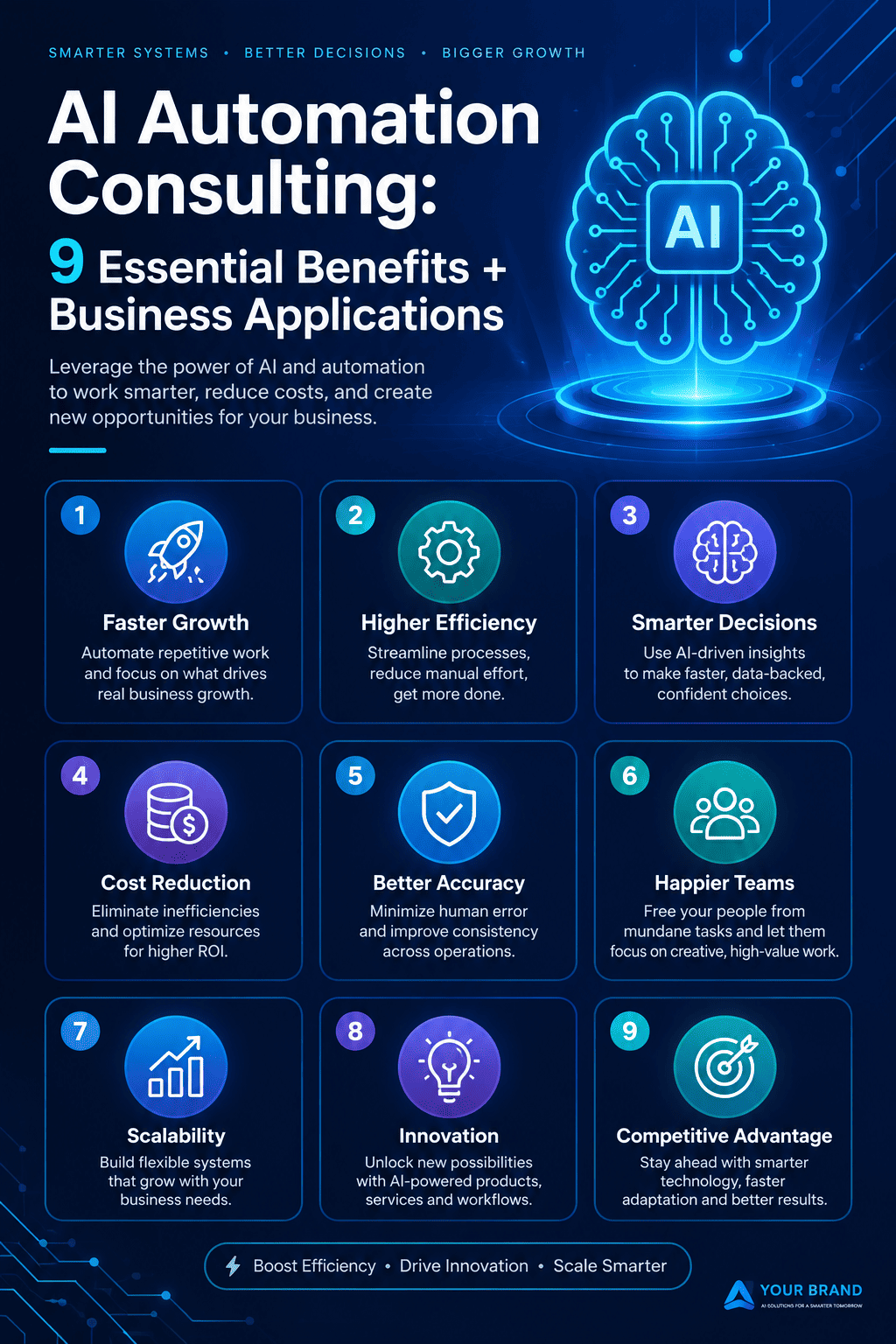
9 Essential Benefits of AI Automation Consulting
Businesses can gain several advantages from a carefully planned automation strategy. The results depend on the quality of implementation, the suitability of the selected processes, and the organization’s ability to manage change.
1. Improved Operational Efficiency
One of the main benefits of ai automation consulting is identifying ways to eliminate unnecessary manual work.
Employees frequently spend valuable time copying information, preparing reports, sorting messages, updating records, and searching for documents. Automating suitable activities allows them to devote more attention to planning, problem-solving, and customer relationships.
For example, an automated reporting workflow can collect information from several approved sources, organize it into a standard format, and prepare a draft report for review.
This reduces repetitive effort while maintaining human responsibility for checking important conclusions.
Read More: How Does AI Automation Work in Customer Support? 9 Essential Steps, Benefits, Tools & Complete Guide
2. Reduced Operating Costs
Manual processes can create costs through employee time, repeated data entry, avoidable mistakes, and inefficient use of resources.
Automation may reduce these expenses by shortening processing times and minimizing routine administrative work. It can also help businesses handle increasing workloads without proportionally increasing manual effort.
However, savings are not automatic. Software subscriptions, implementation, employee training, maintenance, and monitoring all contribute to the total cost.
A realistic financial assessment should compare the full cost of the solution with measurable savings and additional business value.
Read More: Best GTM Digital Agents in AI Sales Automation: 9 Leading Tools and a Complete Guide
3. Greater Accuracy and Consistency
Manual processes are vulnerable to typing mistakes, inconsistent formatting, missing information, and overlooked details.
Automation can apply the same validation rules across repeated transactions. AI systems can also assist with extracting information from documents and identifying unusual patterns.
Nevertheless, AI outputs may contain inaccuracies. A system that misinterprets a document can repeat the error across many records if appropriate checks are absent.
Consultants should therefore establish validation procedures, confidence thresholds, exception handling, and human review for consequential decisions.
Read More: What Is AI Automation Software? 9 Essential Facts, Benefits, Types & Applications
4. Faster Customer Service
Customers increasingly expect businesses to provide timely responses and convenient support.
AI-assisted systems can classify incoming questions, retrieve approved information, suggest responses, and direct requests to the appropriate department. They can also support self-service systems for routine inquiries.
For example, a customer asking about an order may receive an automated status update based on current information from the order-management system.
Sensitive complaints, unusual requests, and complex problems should remain accessible to human representatives. The objective is to improve service speed without sacrificing empathy, accuracy, or accountability.
5. Better Use of Business Data
Organizations often collect large amounts of information without using it effectively.
AI-powered tools can help summarize documents, identify recurring customer concerns, categorize feedback, and detect patterns in operational data. Consultants can integrate these capabilities into reporting and decision-support workflows.
For example, a retailer may analyze customer feedback to identify frequently reported product problems. Managers can then investigate the underlying causes and make informed improvements.
AI-generated insights should be checked against reliable data and appropriate analytical methods. A pattern identified by a model does not automatically establish a cause-and-effect relationship.
6. Increased Scalability
Growing businesses frequently encounter operational bottlenecks as transaction volumes increase.
A properly designed automated workflow can process additional requests without requiring the same increase in manual effort. Cloud-based infrastructure and modular integrations may further support expansion.
However, scalability depends on system capacity, processing costs, data quality, integration reliability, and the availability of human reviewers.
Consultants should assess these factors before recommending solutions for large-scale deployment.
7. Improved Employee Productivity
Automation can reduce repetitive workloads and help employees focus on higher-value activities.
Marketing teams may use AI to prepare content outlines, sales representatives may automate meeting summaries, and administrative staff may use document extraction to reduce manual data entry.
The most effective approach supports employees rather than assuming that every task should be removed from human control.
Clear training, transparent performance expectations, and employee involvement help organizations adopt automation more successfully.
8. Stronger Process Visibility
Automated workflows can create structured records of task status, processing times, errors, approvals, and exceptions.
This information helps managers understand where delays occur and which stages require improvement.
For example, an organization may discover that most invoice-processing delays happen during approval rather than data extraction. Management can then address the actual bottleneck instead of investing in unnecessary technology.
Visibility also supports accountability when access controls and audit records are designed appropriately.
Read More: Zapier Updates News: 5 Latest Features, Improvements, and What They Mean for Users
9. More Consistent Business Decisions
AI-assisted decision support can organize relevant information and highlight patterns that employees might otherwise overlook.
In sales, a system may summarize account activity. In operations, it may flag unusual inventory movements. In customer support, it may group similar complaints.
These capabilities can improve consistency when combined with established policies and reliable evidence.
However, AI should not automatically replace human judgment in decisions involving employment, credit, health, legal rights, or other consequential matters. Appropriate oversight, testing, and accountability remain essential.
Read More: What Are the Best AI Workflow Automation Tools? Top Solutions for Smarter Business Processes
Common AI Automation Consulting Services
Consulting providers offer different services depending on their technical capabilities and the needs of their clients. Some specialize in strategy, while others focus on implementation, integration, or ongoing support.
AI Readiness Assessment
An AI readiness assessment evaluates whether a business has the data, infrastructure, skills, governance, and operational processes needed for successful adoption.
The assessment may examine existing software, data quality, security practices, employee capabilities, and management objectives.
Its purpose is to identify gaps and recommend realistic next steps before major investments are made.
Read More: 7 Essential and Effective Insights on How Google Determines Search Relevance
Workflow Analysis and Optimization
Consultants examine current processes to identify delays, duplicated work, unnecessary approvals, and avoidable manual activities.
They may redesign the workflow before introducing automation. This distinction is important because automating an inefficient process can preserve its original weaknesses.
A simpler, well-designed process often produces better results than a complicated automated system.
Read More: What Is SEO Rank Tracking? A Complete Guide to Measuring Search Performance
AI Chatbot and Virtual Assistant Development
Businesses can use chatbots and virtual assistants to answer routine questions, locate approved information, guide users through standard procedures, and assist employees with internal knowledge searches.
Consultants help define the assistant’s responsibilities, connect it to suitable information sources, establish escalation procedures, and evaluate its responses.
Reliable systems should clearly communicate their limitations and transfer complex requests to qualified human staff.
Robotic Process Automation
Robotic process automation, commonly called RPA, uses software bots to perform repetitive actions in digital applications.
Typical examples include copying information between systems, generating standardized reports, processing structured forms, and updating records.
AI capabilities can extend RPA by helping interpret documents or classify unstructured information. However, conventional automation remains more suitable for tasks governed by stable, explicit rules.
Read More: Do Google Reviews Help SEO? A Clear, Practical Guide to Rankings and Trust
AI Integration and Custom Solutions
Some businesses require connections between AI services and their existing applications. Others need specialized solutions built around unique workflows or industry requirements.
Consultants may develop application programming interface integrations, document-processing pipelines, retrieval-based knowledge assistants, or custom machine learning applications.
The appropriate level of customization depends on the business case. Custom development is not always necessary when existing software can solve the problem reliably.
Read More: What Is Off-Page SEO? A Complete Guide to Building Authority and Trust
Data Analysis and Reporting Automation
Consultants can automate data collection, cleaning, categorization, summarization, and report preparation.
These systems can reduce manual reporting work and help managers access relevant information more quickly.
Data validation and source traceability remain important because inaccurate input can produce misleading reports, even when the automation process itself functions correctly.
Read More: What Is Local SEO? A Complete Guide to Boosting Your Local Visibility
Training and Change Management
Technology adoption requires more than technical implementation.
Employees need to understand the system’s purpose, appropriate use, limitations, security requirements, and escalation procedures. Managers may also need guidance on evaluating results and adjusting existing responsibilities.
Training and change management help reduce confusion and encourage responsible, effective use.