
Best AI Tools for Academic Research Automation: 11 Essential Tools, Features, and Benefits
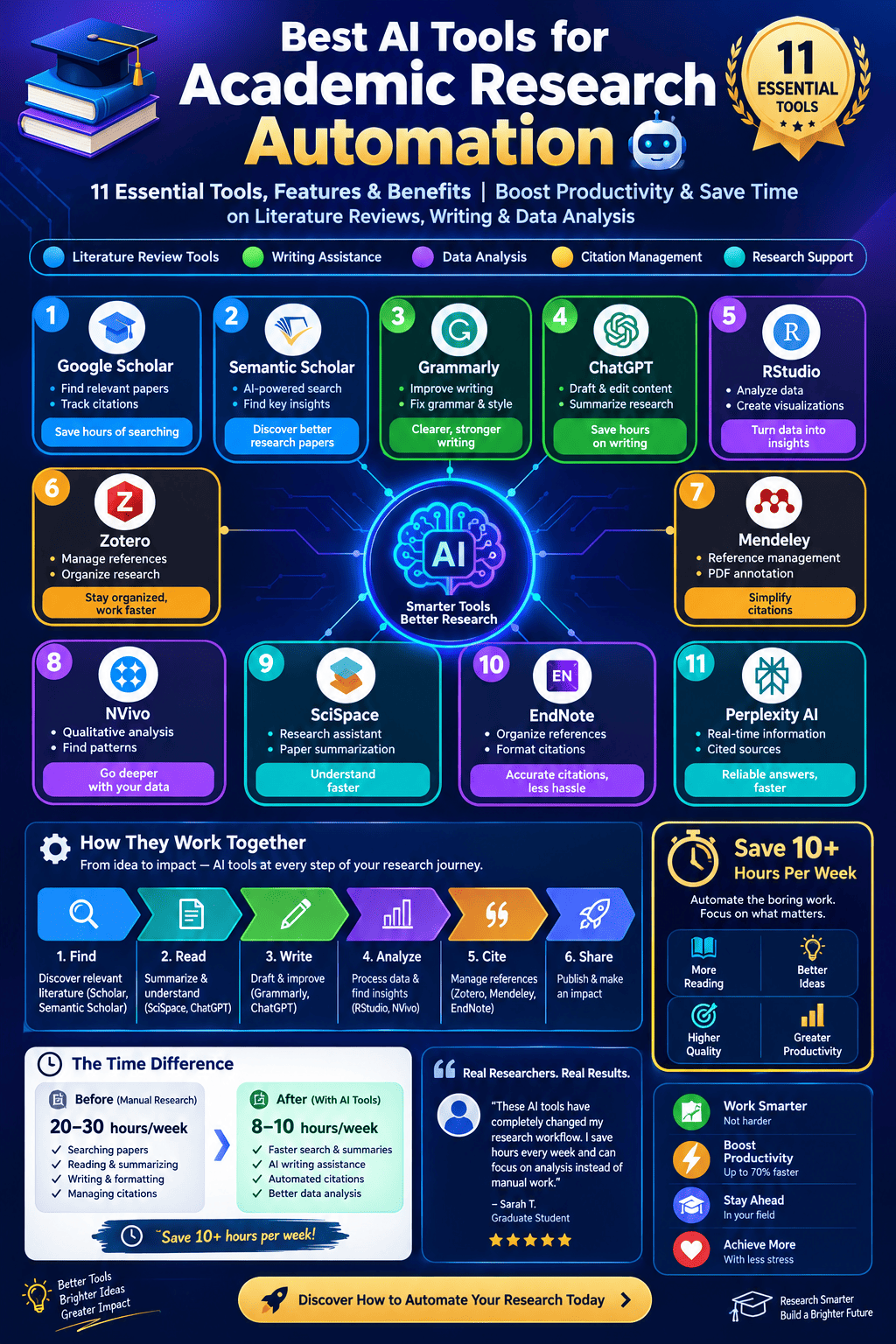
Academic research has become more efficient with the development of artificial intelligence (AI). Researchers, university students, teachers, and postgraduate scholars can now use intelligent software to discover relevant literature, summarize scientific papers, organize references, analyze data, and improve academic writing. Tasks that once required hours of manual effort can often be completed in significantly less time with the right digital tools.
However, choosing the best tools requires more than comparing their features. Researchers must consider accuracy, ease of use, privacy, citation quality, research requirements, and cost. A tool that works well for finding scientific papers may not be suitable for statistical analysis or systematic reviews.
This is where academic research automation becomes particularly valuable. It combines AI-powered applications, research databases, reference managers, and workflow automation to simplify repetitive research activities while allowing researchers to retain control over their work.
Whether you are preparing a university assignment, writing a literature review, developing a research proposal, or conducting a scientific investigation, understanding the available tools can help you build a more productive research workflow.
This article explores 11 useful AI tools, their features, benefits, limitations, and practical applications. It also explains how to select suitable software, combine different applications, and maintain academic integrity when using AI.
Read More: Cybersecurity AI Automation 2026: 9 Essential Trends, Benefits, Risks & Complete Guide
What Is Academic Research Automation?
Academic research automation refers to the use of artificial intelligence, software applications, and automated workflows to simplify or accelerate repetitive tasks involved in academic investigation.
These tasks may include searching scholarly databases, identifying relevant publications, extracting information from research papers, organizing references, transcribing interviews, analyzing datasets, and preparing research summaries.
Traditional research often requires researchers to move manually between databases, downloaded documents, spreadsheets, citation managers, and writing applications. Automation connects or streamlines these activities, reducing unnecessary repetition and making it easier to manage large amounts of information.
For example, a postgraduate student investigating renewable energy may use an AI research assistant to identify relevant publications, a reference manager to organize citations, a spreadsheet to extract study characteristics, and a statistical application to analyze experimental data.
Although each application performs a different function, together they create a more organized research process.
It is important to understand that automation does not eliminate the need for human judgment. AI-generated summaries can omit important qualifications, suggested references may be irrelevant, and automated analyses can produce misleading results when the input data or assumptions are incorrect. Researchers must therefore verify evidence, inspect original sources, and interpret findings independently.
Read More: AI Automation Solutions: 9 Essential Benefits, Types, Tools & Implementation Guide
Why Is Research Automation Important?
Research projects frequently involve repetitive activities that consume time without necessarily contributing directly to scientific discovery. Automation can reduce this burden and allow researchers to concentrate on critical thinking, experimental design, interpretation, and original contributions.
The main advantages include:
- Time efficiency: Reduces the effort required to discover and organize relevant literature.
- Better organization: Keeps research papers, notes, and references structured.
- Faster literature screening: Helps researchers identify potentially relevant publications.
- Improved productivity: Simplifies repetitive administrative and documentation tasks.
- Data management: Supports the cleaning, transformation, and analysis of research datasets.
- Writing assistance: Helps improve clarity, structure, and readability.
- Reproducibility: Certain tools preserve search strategies, screening decisions, code, and analytical procedures.
The actual benefits depend on the selected applications, the quality of the available evidence, and the researcher’s ability to evaluate automated outputs.
Read More: AI Automation in Healthcare: 9 Essential Benefits, Applications, Challenges & Future Trends
11 Best AI Tools for Academic Research Automation
The following tools serve different purposes, from discovering scholarly publications to checking citations and analyzing research documents. They are selected according to their practical usefulness rather than a claim that one application is universally superior. Feature availability and subscription limits can change over time.
1. Elicit
Best for literature reviews and structured evidence extraction
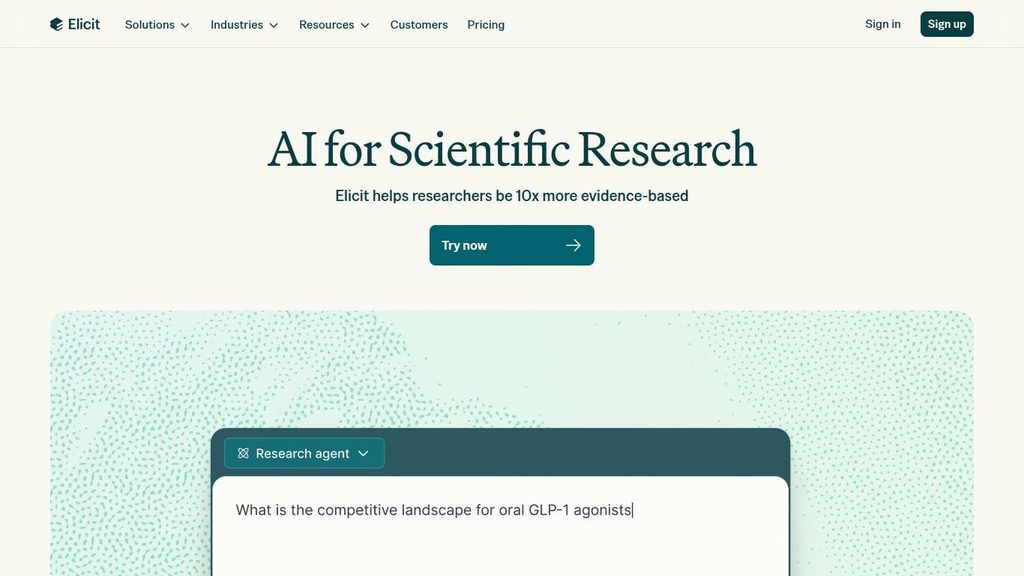
Elicit is designed to help researchers find academic papers, summarize findings, and extract information into structured tables. It is particularly useful when a project requires comparing numerous studies according to consistent criteria.
Key features
- Natural-language research questions and paper discovery.
- AI-generated summaries of research findings.
- Structured extraction of study methods, populations, and outcomes.
- Support for screening and organizing literature reviews.
Practical example: A public health researcher studying the relationship between physical activity and sleep quality can use Elicit to identify relevant studies and compare their sample sizes, research methods, and reported findings.
Limitation: Automated extraction can misinterpret a table or overlook an important qualification. Researchers should verify each extracted value against the original paper.
Read More: AI Automation News: 11 Major Trends, Breakthroughs & Business Impacts in 2026
Website: elicit.com
2. Consensus
Best for evidence-based questions
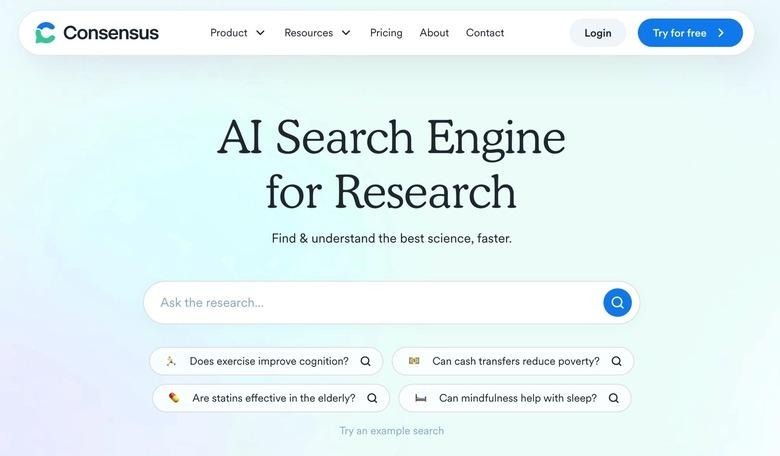
Consensus helps users explore scientific literature through questions written in ordinary language. Rather than relying entirely on general web pages, it focuses on research-based evidence and provides links to relevant studies.
Key features
- Research-oriented question answering.
- Evidence summaries linked to scholarly publications.
- Tools for exploring findings across multiple studies.
- Support for quickly investigating scientific questions.
Practical example: A student investigating whether regular exercise improves sleep can use Consensus to identify studies addressing the question and examine whether the findings are consistent.
Limitation: A short evidence summary cannot replace an assessment of study quality, research design, confounding factors, and conflicting results. A numerical or visual indication of consensus should not be treated as definitive proof.
Website: consensus.app
3. Scite
Best for evaluating citation context
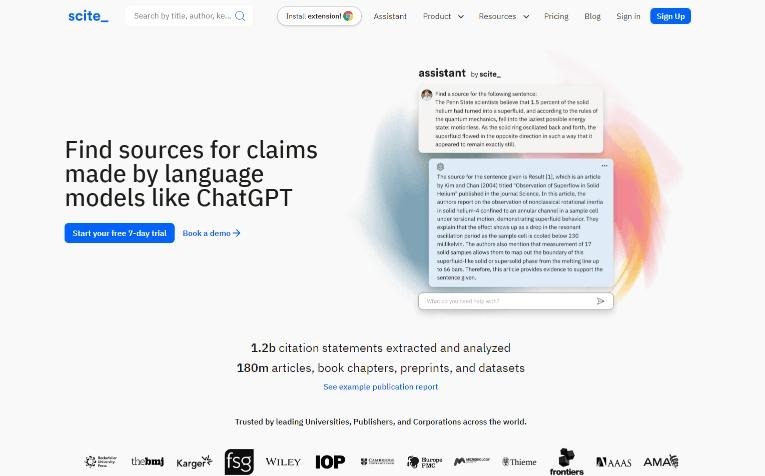
Scite offers Smart Citations that help researchers investigate how subsequent publications refer to earlier studies. Its citation-context features can help identify references that support, contrast with, or mention previous findings.
Key features
- Citation-context analysis.
- Search across scholarly literature.
- Investigation of supporting and contrasting references.
- Tools for checking the research context surrounding a claim.
Practical example: Before relying on a frequently cited paper about a teaching method, a researcher can inspect later publications to see whether its findings have been supported, challenged, or discussed with qualifications.
Limitation: Citation classifications can be imperfect. A contrasting citation does not automatically invalidate a paper, and a supporting citation does not guarantee that the original finding is correct.
Read More: AI Automation Platform: 9 Essential Benefits, Features, Types & Applications
Website: scite.ai
4. Semantic Scholar
Best for broad scholarly discovery
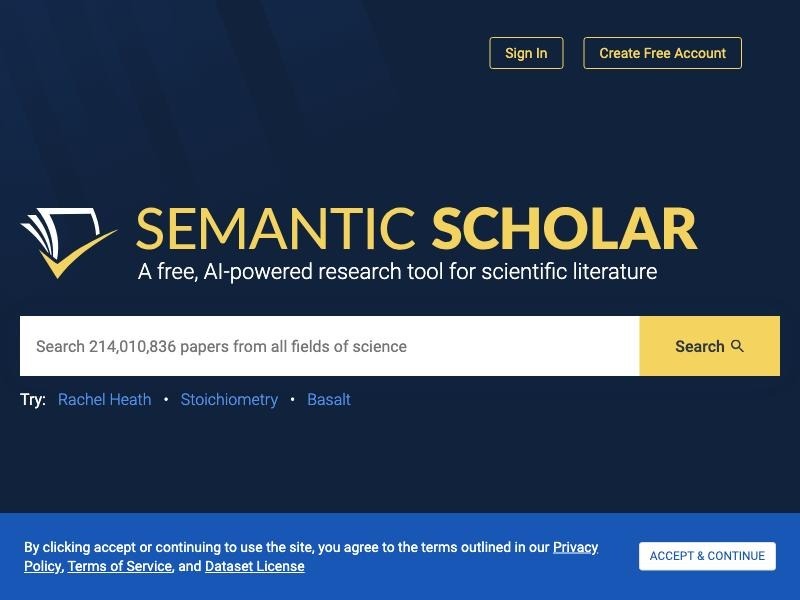
Semantic Scholar is an AI-powered research search engine that helps users discover scientific publications and navigate relationships between papers. It is a useful starting point for students and independent researchers who need to explore a topic without immediately purchasing a subscription.
Key features
- Search for scholarly publications.
- Paper summaries and relevant metadata where available.
- Citation navigation and related-paper discovery.
- Author profiles and research feeds.
Practical example: A physics student exploring semiconductor materials can search for foundational papers, identify related studies, and follow citation links to more recent work.
Limitation: Full-text availability varies, and an indexed abstract may not provide enough detail to evaluate a paper’s methodology or conclusions.
Read More: Gridone AI Automation: A Complete Guide to Features, Benefits, Use Cases, and Future Potential
Website: semanticscholar.org
5. SciSpace
Best for understanding complex research papers
SciSpace helps users explore research papers, ask questions about documents, and compare information from multiple publications. It can be especially useful when a paper contains unfamiliar terminology, mathematical expressions, or technical descriptions.
Key features
- Question answering about research papers.
- AI-assisted summaries and explanations.
- Literature comparison and information extraction.
- Tools for navigating technical documents.
Practical example: An engineering student reading a paper about computational fluid dynamics can ask for an explanation of its numerical method before checking the relevant equations and assumptions in the original text.
Limitation: Simplified explanations may omit technical qualifications. Always inspect the original equations, figures, and methodology when accuracy matters.
Website: scispace.com
6. ResearchRabbit
Best for discovering connected research
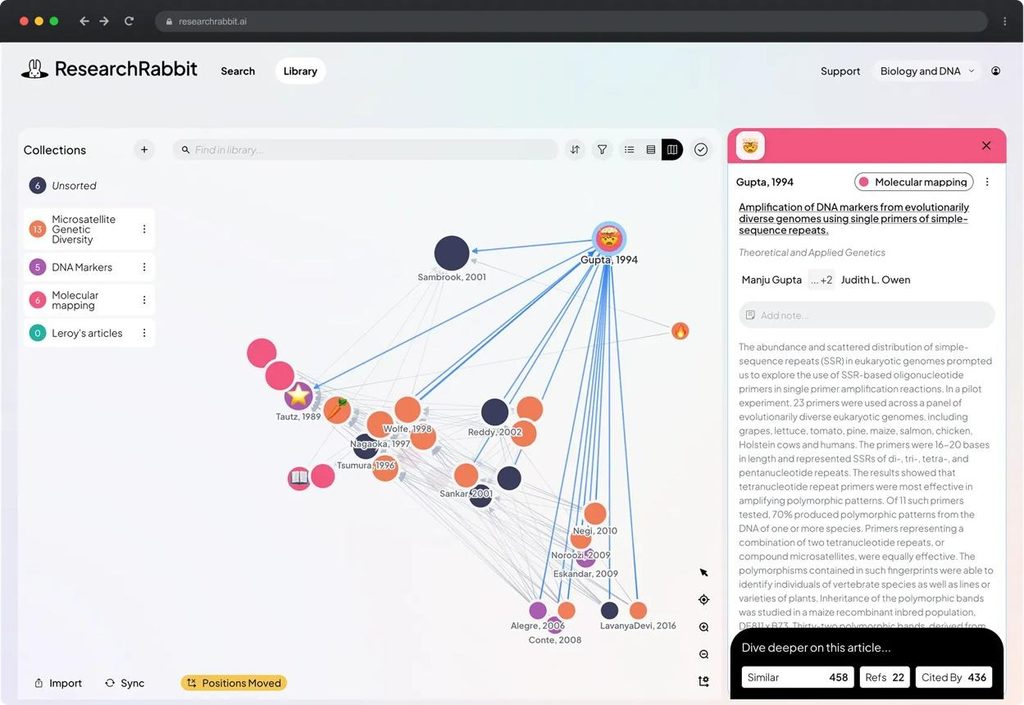
ResearchRabbit helps researchers expand a reading list by exploring connections among papers, authors, and related publications. Its visual discovery approach can reveal relevant work that a simple keyword search might miss.
LibGuides at University of California Merced
Key features
- Visual exploration of research relationships.
- Recommendations based on selected papers.
- Author and publication discovery.
- Collections for organizing literature.
Practical example: After finding three important studies on solar-cell efficiency, a researcher can use ResearchRabbit to discover related publications and trace the development of the research topic.
Limitation: Recommendations depend on the available scholarly network and the initial papers. This tool should complement, not replace, systematic database searches.
Read More: AI Automation Consulting: 9 Essential Benefits, Services, Strategies, and Business Applications
Website: researchrabbit.ai

7. NotebookLM
Best for analyzing a collection of selected sources
NotebookLM allows users to work with a defined collection of source materials and ask questions about their contents. This makes it useful after the initial literature search, when researchers need to compare documents they have already selected.
Key features
- Question answering grounded in supplied sources.
- Source-linked responses and summaries.
- Organization of materials in notebooks.
- Study-oriented summaries and other supported formats.
Practical example: A postgraduate student can add several research papers, institutional reports, and project documents to a notebook and ask how their methodologies differ.
Limitation: Answers depend on the sources provided and the tool’s interpretation of them. Missing documents, incomplete source coverage, or extraction errors can affect the results.
Read More: AI SEO Automation Features: 9 Essential Benefits, Tools, and Strategies for Better Rankings
Website: notebooklm.google.com

8. Zotero
Best for reference management and citation workflows
Zotero is a reference manager rather than a standalone AI research assistant. It helps users collect publications, organize research libraries, attach files, and insert citations into academic documents. It is an important component of an automated research workflow because it reduces manual citation management.
Key features
- Collection and organization of bibliographic references.
- Browser-based capture of publication details.
- Citation and bibliography generation.
- Integration with supported word processors and community tools.
Practical example: A student preparing a dissertation can save papers in Zotero, categorize them by chapter, and generate a bibliography in the citation style required by the university.
Limitation: Imported metadata may contain errors, and citation formatting should be checked against the relevant style guide. AI features generally require separate tools or integrations.
Website: zotero.org

9. ChatGPT
Best for flexible research assistance
ChatGPT can assist with brainstorming research questions, explaining unfamiliar concepts, outlining literature reviews, developing code, interpreting selected data, and improving academic prose. Depending on the tools and access available, it can also help investigate sources and analyze uploaded documents.
Key features
- Research-question refinement and planning.
- Explanations of complex concepts.
- Assistance with coding and data analysis.
- Summarization and language revision.
- Support for organizing research workflows.
Practical example: A researcher studying student performance can use ChatGPT to develop a preliminary analysis plan, draft Python code, and explain what a regression coefficient means.
Limitation: General-purpose AI can make factual errors, generate nonexistent references, or produce incorrect code. Verify citations independently and test any analytical code before trusting its output.
Website: chatgpt.com

10. Paperpal
Best for academic language and manuscript preparation
Paperpal focuses on improving academic writing. It can assist with language refinement, clarity, grammar, and other manuscript-preparation tasks, making it useful during the final stages of a research project.
Key features
- Grammar and language suggestions.
- Academic-style editing.
- Support for improving sentence clarity.
- Writing assistance for research manuscripts.
Practical example: A researcher whose first language is not English can use Paperpal to identify awkward sentences and improve readability before submitting a manuscript to a journal.
Limitation: Editing suggestions may change the intended meaning of a technical sentence. Review all revisions carefully and follow the target journal’s AI-use policy.
Website: paperpal.com
11. Connected Papers
Best for visual literature exploration
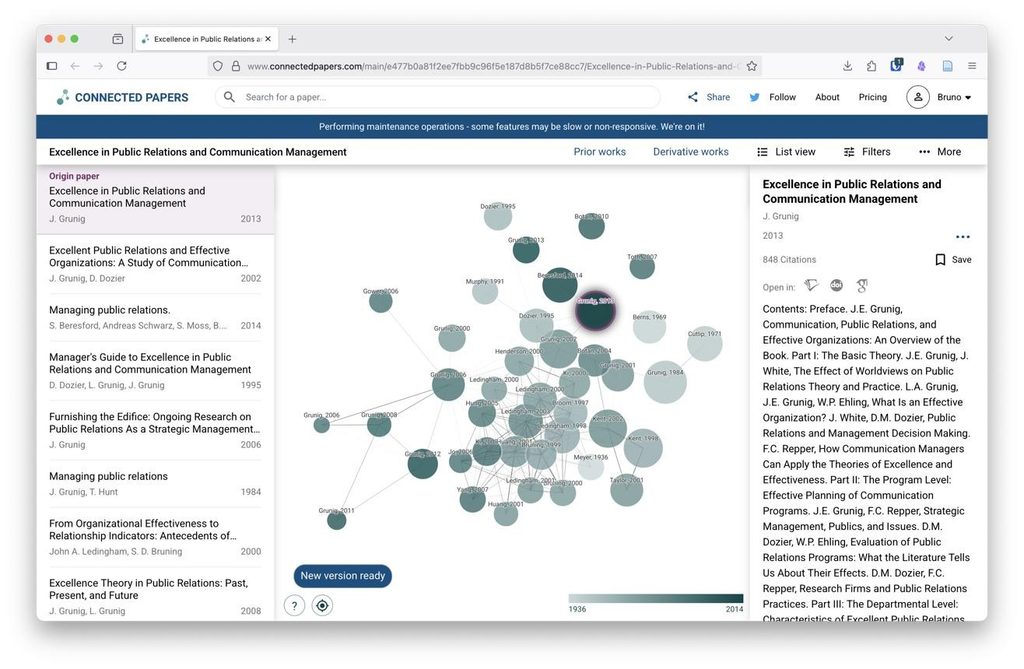
Connected Papers creates visual graphs of related academic papers around a selected publication. It helps researchers identify neighboring studies and explore a research field without relying exclusively on keyword matching.
Key features
- Visual maps of related papers.
- Discovery of foundational and connected studies.
- Exploration of research relationships.
- Support for expanding an initial reading list.
Practical example: A student who discovers an influential paper on machine learning in medical imaging can use a literature graph to find closely related studies and develop a broader understanding of the field.
Limitation: A similarity graph does not represent a complete systematic review, and relatedness does not establish that one paper supports another.
Website: connectedpapers.com
Comparison of the Best AI Research Tools
The following table summarizes which tools are most suitable for common research tasks.
| Research task | Recommended tool | Main advantage |
| Finding scientific papers | Semantic Scholar | Scholarly discovery |
| Conducting literature reviews | Elicit | Structured evidence extraction |
| Investigating scientific questions | Consensus | Research-based answers |
| Checking citation context | Scite | Supporting and contrasting citations |
| Understanding technical papers | SciSpace | Document explanations |
| Mapping related literature | ResearchRabbit | Visual discovery |
| Analyzing selected documents | NotebookLM | Source-grounded questions |
| Managing references | Zotero | Citation organization |
| Planning and coding | ChatGPT | Flexible assistance |
| Editing academic manuscripts | Paperpal | Language refinement |
| Exploring paper connections | Connected Papers | Literature graphs |
No single application handles every stage equally well. A combination of two to five complementary tools is often more practical than paying for multiple applications with overlapping features.
How to Use AI Tools to Automate an Academic Research Workflow
An effective research process should connect each stage of the investigation rather than treat every application as a separate destination.
Step 1: Discover relevant literature
Use Semantic Scholar, Consensus, or Elicit.
Step 2: Expand the literature collection
Use ResearchRabbit or Connected Papers.
Step 3: Screen and compare studies
Use Elicit and inspect the original papers.
Step 4: Organize evidence and references
Use Zotero and NotebookLM.
Step 5: Verify, analyze, and write
Use Scite, appropriate analysis software, ChatGPT, or Paperpal.
Step 1: Define a Clear Research Question
Before using AI applications, establish a focused research question. A broad question such as “How does technology affect education?” may produce an unmanageable collection of studies.
A more focused question might investigate how AI-based tutoring affects mathematics achievement among secondary-school students.
A precise question makes it easier to identify relevant search terms, define inclusion criteria, and evaluate whether a paper contributes to the investigation.
Step 2: Search for Relevant Publications
Use scholarly discovery tools to identify potentially relevant publications. Try several related search terms rather than relying on a single query.
For example, a researcher studying AI-assisted learning might search for artificial intelligence in education, intelligent tutoring systems, adaptive learning, and student achievement.
Record the databases searched, search dates, and queries used. For systematic reviews, preserve the complete search strategy and follow an appropriate reporting guideline.
Step 3: Screen and Extract Information
Once you have collected candidate papers, evaluate their titles, abstracts, and full texts against predefined criteria.
AI tools can help extract study characteristics into a table containing authors, publication year, research design, sample size, intervention, outcomes, and limitations.
However, do not accept extracted information without checking it against the original publication. This is especially important when sample sizes, numerical results, or statistical measures determine your conclusions.
Step 4: Organize References and Notes
Use a reference manager such as Zotero to maintain consistent bibliographic records. Create folders or collections for different themes and research questions.
Keep your notes separate from the original source material, and record page numbers or section headings when preparing quotations and evidence summaries.
This approach reduces the likelihood of losing important sources or confusing an AI-generated paraphrase with the author’s actual statement.
Step 5: Verify the Evidence and Prepare the Manuscript
Before drafting the final report, inspect the original papers supporting each major claim. Scite can help investigate citation context, while NotebookLM and ChatGPT can assist with organizing or explaining material.
Use writing assistants to improve clarity and grammar, but retain responsibility for the argument, interpretation, and conclusions.
The final manuscript should accurately represent the evidence and comply with the institution’s or journal’s requirements for disclosing AI assistance.
Benefits of Academic Research Automation
When implemented carefully, academic research automation can improve productivity without sacrificing scholarly rigor.
1. Reduced Time Spent on Repetitive Tasks
Searching, sorting, summarizing, and formatting references can consume a considerable proportion of a researcher’s working time. Automated tools can accelerate these activities, especially when many papers must be considered.
The time saved can be redirected toward designing experiments, evaluating evidence, and interpreting results.
2. More Organized Literature Reviews
Structured extraction and reference-management tools help researchers organize findings consistently. They can make it easier to compare different methodologies, identify recurring themes, and locate areas requiring further investigation.
3. Improved Access to Complex Information
AI explanations can help readers approach unfamiliar concepts, technical vocabulary, and complicated research methods.
Nevertheless, explanations should be treated as learning aids. Researchers must consult original equations, experimental procedures, and results whenever technical accuracy is essential.
4. Better Research Planning
AI assistants can help refine research questions, generate preliminary outlines, suggest variables, and develop draft analysis plans.
These suggestions provide a starting point, not a substitute for methodological expertise or consultation with a qualified supervisor.
5. More Efficient Writing and Editing
Writing assistants can identify grammatical errors, improve sentence structure, and suggest clearer organization. Reference managers can reduce manual citation formatting, although the resulting references still require verification.
Limitations and Risks of AI Research Automation
Despite its benefits, academic research automation introduces challenges that researchers must address before relying on automated outputs.
Inaccurate information: AI-generated summaries may misinterpret findings, overlook limitations, or combine results from different contexts.
Incomplete literature coverage: Search tools do not necessarily index every relevant publication. Language restrictions, database coverage, publication delays, and inaccessible full texts can create gaps.
Fabricated or incorrect references: General-purpose chatbots can produce plausible-looking but nonexistent citations or incorrect bibliographic details. Every reference should be verified using a reliable scholarly record.
Bias in the evidence: Automated recommendations can reproduce biases in the underlying literature, including underrepresentation of certain populations, regions, or research approaches.
Privacy and confidentiality: Unpublished manuscripts, identifiable participant data, confidential peer-review documents, and sensitive institutional records should not be uploaded to an external service without checking its data-handling terms and obtaining any necessary authorization.
Overdependence on automation: Accepting generated summaries without reading primary sources can weaken critical thinking and lead to unsupported conclusions.
Researchers should also distinguish between a tool that helps locate evidence and one that evaluates evidence quality. Finding a large number of relevant papers does not establish that the papers are reliable or that their findings agree.
How to Choose the Right AI Research Tool
Selecting suitable software depends on your discipline, research design, budget, and the stage of your project.
Consider the following questions before choosing an application:
- What task needs improvement? Decide whether your main challenge is literature discovery, screening, citation management, data analysis, or writing.
- Does the tool provide traceable evidence? Prefer outputs that link directly to the relevant paper or source passage.
- Can it handle your research materials? Check whether it supports your file formats, languages, disciplines, and document volume.
- Is the cost sustainable? Review free-tier restrictions, subscription limits, institutional access, and export options.
- Does it protect sensitive information? Review data retention, sharing, and training policies before uploading research materials.
- Can your workflow be reproduced? Preserve search strategies, screening decisions, source documents, analytical code, and relevant version information.
For students with limited budgets, a practical starting combination is Semantic Scholar, Zotero, and the free tiers of selected research assistants. Researchers conducting large literature reviews may benefit from adding Elicit or Scite, while those analyzing a fixed collection of papers may prefer NotebookLM.
For quantitative projects, use appropriate statistical software such as R, Python, or a validated specialist application rather than relying on a chatbot alone to calculate or interpret results.
Best Practices for Responsible AI Use in Academic Research
Responsible automation requires transparency, verification, and human oversight.
First, verify every important claim against its primary source. Second, document how AI was used, particularly when it influenced screening, data extraction, coding, or interpretation. Third, follow institutional and journal policies regarding disclosure and authorship.
Researchers should never fabricate citations, misrepresent AI-generated text as verified evidence, or allow an automated tool to determine scientific conclusions without appropriate evaluation.
For systematic reviews, maintain a reproducible search strategy and follow the relevant review methodology. AI-assisted screening can help prioritize records, but decisions about eligibility should follow documented criteria and appropriate quality controls.
Finally, preserve the distinction between assistance and authorship. Researchers remain responsible for the accuracy, originality, ethics, and integrity of the submitted work.
Future of AI in Academic Research
AI research applications are developing toward more integrated workflows that combine literature discovery, document analysis, citation checking, data processing, and writing assistance.
Future systems may make it easier to move information between research databases, reference managers, statistical applications, and collaborative workspaces. Automated agents may also support recurring literature alerts and preliminary screening.
However, greater automation will not eliminate the need for sound research methods. More sophisticated tools can still produce misleading results if their sources are incomplete, their assumptions are inappropriate, or their outputs are not independently verified.
The most useful developments will be those that improve transparency, traceability, reproducibility, and researcher control rather than simply generating more text.
Frequently Asked Questions (FAQ)
1. What is the best AI tool for academic research automation?
Elicit is a strong option for structured literature reviews and information extraction. Consensus is useful for exploring scientific questions, Semantic Scholar supports scholarly discovery, and Scite helps investigate citation context. The best choice depends on the task.
2. Which AI research tools are free?
Semantic Scholar and Zotero offer useful free research capabilities. ResearchRabbit and Connected Papers also provide free access with varying feature or usage limits. Elicit, Consensus, and several general-purpose AI assistants offer free access tiers, but current restrictions should be checked on their official websites.
3. Can AI automate a complete literature review?
AI can assist with searching, preliminary screening, summarization, and structured data extraction. However, a rigorous literature review also requires a defensible search strategy, explicit inclusion criteria, assessment of evidence quality, and verified synthesis. AI should not replace these methodological responsibilities.
4. Is ChatGPT suitable for academic research?
Yes. ChatGPT can help refine research questions, explain concepts, organize notes, develop code, and improve writing. However, researchers must verify factual claims, citations, calculations, and analytical outputs before relying on them.
5. Can AI tools generate accurate citations?
Some research tools retrieve citations directly from scholarly records and link answers to sources. Nevertheless, errors can occur. Verify authors, titles, publication dates, journal details, identifiers, and the specific claims attributed to each source.
6. Which tool is best for reading research papers?
SciSpace and NotebookLM are useful for asking questions about documents and understanding selected sources. Their explanations should be checked against the original papers, particularly for equations, methods, and numerical results.
7. How can researchers automate reference management?
Zotero can collect bibliographic records, organize research materials, and generate citations and bibliographies in supported word processors. Researchers should review imported metadata and confirm that the required citation style has been applied correctly.
8. Is academic research automation suitable for beginners?
Yes. Beginners can start with a scholarly search engine, a reference manager, and one AI assistant. Learning how to verify sources and distinguish evidence from generated explanations is more important than using many tools.
9. Can AI research tools replace human researchers?
No. AI tools can accelerate routine tasks, but human researchers remain responsible for research design, critical evaluation, ethical decisions, interpretation, and the validity of conclusions.
10. How can researchers use AI without compromising academic integrity?
Follow institutional and journal policies, verify every important claim, cite original sources, protect confidential information, document AI assistance when required, and ensure that the final work reflects your own understanding and responsible scholarly judgment.
Conclusion
The best AI research tools are those that solve specific problems within a well-designed research process. Elicit can simplify literature reviews, Consensus can help investigate scientific questions, Scite can provide useful citation context, Semantic Scholar can support paper discovery, and Zotero can organize references. SciSpace, NotebookLM, ChatGPT, Paperpal, ResearchRabbit, and Connected Papers provide complementary capabilities.
When combined thoughtfully, these applications can make academic research automation more efficient, organized, and manageable. The key is to automate repetitive work while preserving the researcher’s responsibility for evidence, accuracy, ethics, and original thinking.
AI should serve as an assistant to rigorous scholarship, not a replacement for it. Researchers who combine appropriate tools with critical evaluation and transparent methods will be better positioned to produce reliable, reproducible, and meaningful academic work.